How Deliveroo manages and scales multiple websites across markets with Prismic
Summary
- Deliveroo is a global food delivery company managing multiple websites for different audiences, including restaurants, riders, and businesses, across several markets.
- As the website ecosystem grew, marketing teams struggled to update and improve pages, limiting experimentation and speed.
- Deliveroo restructured its websites on Prismic, giving teams clear ownership, reusable page structures, and the ability to publish and optimize content independently across markets.
The challenge: scaling a multi-site website
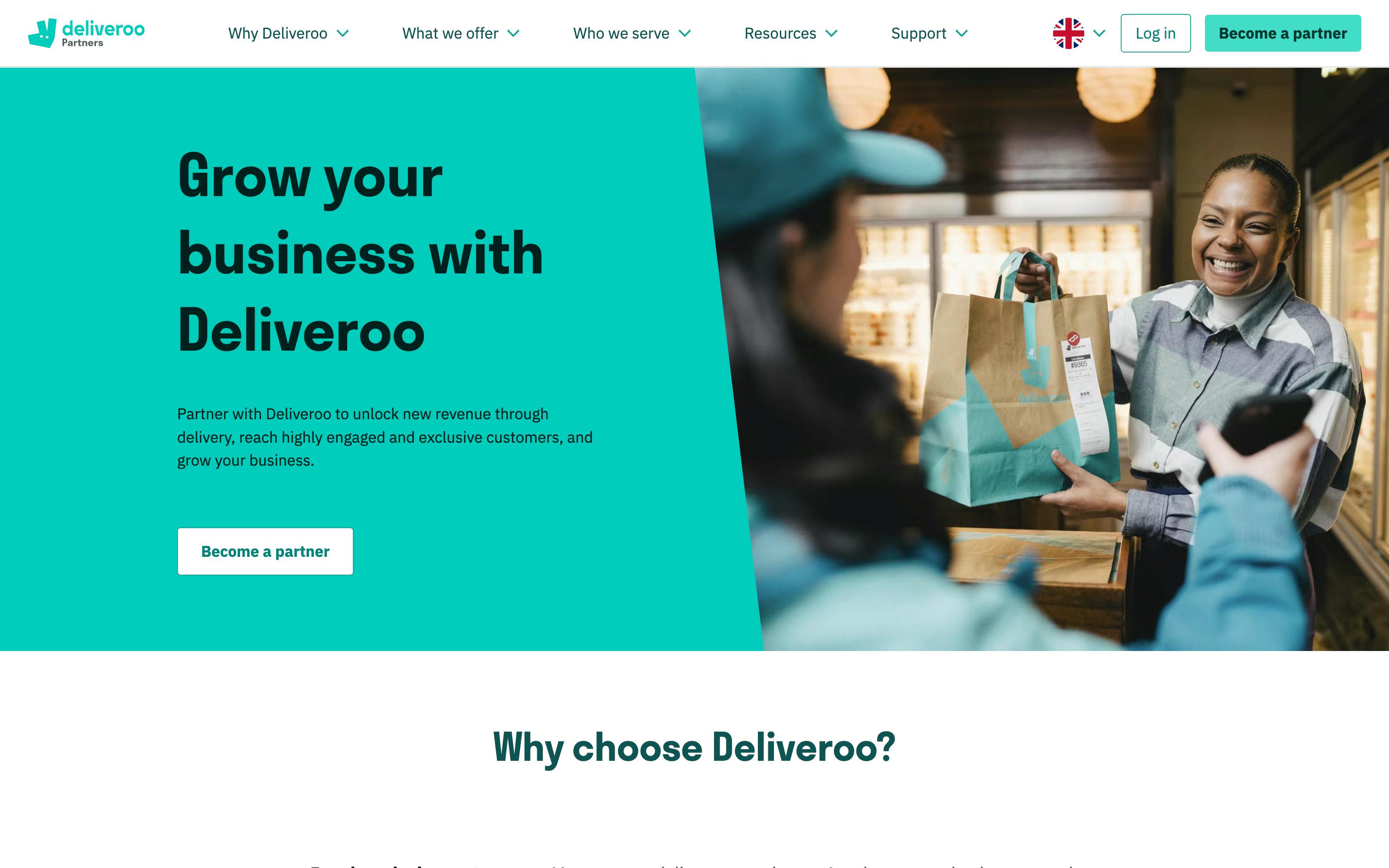
As Deliveroo grew, its website ecosystem became harder to evolve. While Prismic was already in place, parts of the Partner website had limited flexibility. Marketing teams could not easily update pages or launch new ones without technical support.
For several years, even small changes required developer involvement, which slowed campaigns and limited what teams could do with the website.
As Serena Maddalena, Senior B2B Marketing Specialist, explained:
"For quite sometime, our team didn’t have the flexibility of updating content. This meant, we weren’t tapping into the full potential of our website."

This lack of flexibility had a direct impact on business goals. The marketing team was responsible for attracting and educating restaurants, yet the website could not easily support ongoing optimization, content experiments, or market-specific updates.
The solution: rebuilding the website structure to give teams more flexibility
Deliveroo decided to rebuild the Partner and Deliveroo for Work websites on Prismic with a clearer structure and stronger ownership model. Working with an external agency, the team redesigned the content architecture to support both consistency and flexibility.
Each site was given its own Prismic instance, with shared patterns across teams. Pages are built from predefined components, so contributors focus on content rather than layout decisions. This reduced errors and made it easier for non-technical teams to publish confidently.
The B2B marketing team now owns its website day to day. Landing pages, blogs, and campaign pages can be created and updated directly by marketers, while tech teams step in only when new components are needed.
As Serena Maddalena, Senior B2B Marketing Specialist, described it:
“As a marketing team, we now own the website. We can publish our content updates, landing pages, and even run a blog without relying on technical support for every change.”
Having multiple websites on Prismic also created shared learning across teams. The Partner site was rebuilt first, and the Deliveroo for Work team reused both technical patterns and processes. Even though instances are kept separate, teams benefit from speaking the same CMS language and sharing experience.
The results: faster publishing, repeatable rollouts, and room to improve over time
- Independent publishing at scale: The marketing team now manages nine locales across eight markets, with marketers able to create, update, and publish pages without relying on developers.
- Faster time to launch: New landing pages can go from draft to live in about a week, with complex pages built in Prismic in under an hour once content is approved.
- Repeatable market rollouts: Page structures and processes created for the UK site are reused across markets, reducing effort when launching or updating local sites.
- Ongoing experimentation: Teams can test layouts, CTAs, and form placement directly on the website, making it possible to validate ideas and improve conversion rates over time.
- Improved long-term performance: After an expected dip following a domain change, engagement and SEO performance are recovering, with teams now able to actively optimize instead of being blocked by tooling.
“We can now make experiments. I can change the position of a form myself and then prove the impact on conversion.”
Bonus tip from Deliveroo
If you are rebuilding a website for scale, invest early in structure and training. Deliveroo’s advice is simple: make sure the agency or engineers who build your setup truly understand how Prismic works. A well-designed content model upfront makes it far easier for marketing teams to take ownership later.