7 Best Headless CMS for SEO in 2026 (Schema, Speed & AI Visibility)
 By Alison Brunk
The best headless CMS platforms for SEO in 2026 include Prismic, Ghost, Payload, Strapi, Kontent.ai, Storyblok, and Contentful.
SEO performance is important because it doesn't matter how well-designed your website is or how strong your product is if your target audience can't find you via search engines. But besides traditional search, you now also need to position your website to appear on AI platforms like ChatGPT, Perplexity, and Google's AI Overviews, which people are increasingly using to discover new information and research products.
In this guide, we will explore how the above platforms deliver the best value for organic search and AI search visibility, as well as the limitations you should know. Let’s dive in.
TL;DR (key takeaways)
- All 7 platforms covered in this guide offer strong foundations for SEO, and several go further with dedicated tools for AI search visibility and GEO optimization.
- Prismic is best for scaling SEO and GEO landing pages with AI, without needing developer resources for every update.
- Ghost is best for bloggers and content publishers who want strong out-of-the-box SEO without a complex technical setup.
- Payload is best for developer teams who want granular, code-level control over their SEO infrastructure.
- Strapi is best for teams who prefer a plugin-driven approach to SEO customization and want full control over their content architecture.
- Kontent.ai is best for enterprise teams looking to automate SEO and GEO improvements at scale with AI agents.
- Storyblok is best for teams that want AI search monitoring and GEO optimization built into their content workflow.
- Contentful is best for large organizations managing content at scale across multiple regions and channels.
How We Selected the Best Headless CMS Platforms for SEO
You can use pretty much any CMS to launch a website. But not everyone will give you superior SEO performance.
For this list, we focused specifically on platforms that
- Gives teams fine-grained control over the technical factors that drive organic visibility.
- Positions you for AI search visibility, which has become a new frontier of search.
The following platforms are the strongest options in 2026 for teams that need superior SEO and GEO.
The table below offers a quick side-by-side summary before we go into each platform in detail.
Platform | Best For | SEO Strengths | Offers AI Visibility Features | Pricing |
|---|---|---|---|---|
Prismic | AI-powered SEO and GEO landing pages and websites | Landing page builder, image optimization, auto-generated metadata, internal linking | ✅ | Starts from $10/ month |
Ghost | Out-of-the-box SEO without complex technical setup | Automatic metadata, XML sitemaps, canonical tags, structured data | ❌ | Starts from $15/ month |
Payload | Developer-first SEO controls | Native SEO plugin, real-time search preview, custom field injection | ❌ | Free (open-source) |
Strapi | Plugin-driven approach to managing SEO | Flexible metadata, structured data, SEO plugins | ❌ | Starts from $45/ month |
Kontent.ai | Content audits and SEO improvements with AI agents | AI-powered SEO audits, content freshness tools, localization | ✅ | Custom pricing |
Storyblok | AI-search monitoring | AI SEO plugin, content observability, structured content blocks | ✅ | Starts from €90.75/ month |
Contentful | Enterprise-scale SEO mgmt | Structured content modeling, AI Actions, marketplace SEO apps | ✅ | Starts from $300/ month |
7 Best Headless CMS Platforms for SEO
1. Prismic
Best for: AI-powered SEO and GEO
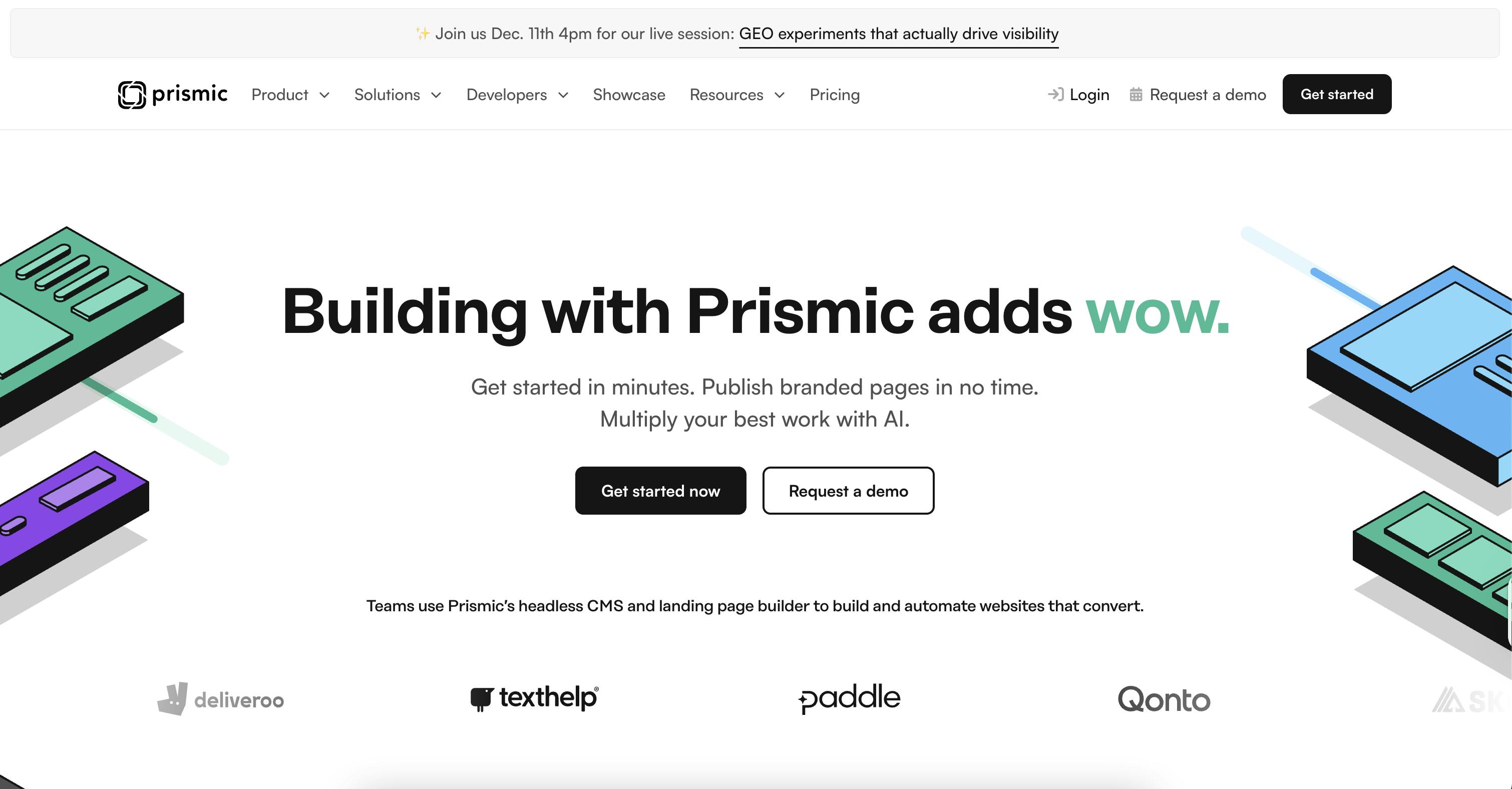
Prismic is a headless CMS built for both developers and content teams, designed to give each side the control they need without getting in each other's way. Developers build reusable content components called Slices, which content teams then use to create and manage pages independently via a no-code Page Builder.
The platform is particularly strong for teams focused on organic growth, with built-in tools for scaling SEO and GEO landing pages, managing metadata, and optimizing technical performance.
SEO strengths
- AI-powered SEO and GEO landing page builder: Prismic lets you scale hundreds of optimized landing pages from a single base template and a CSV of target keywords. What would traditionally take months can be done in hours, allowing teams to capture long-tail search queries and AI-powered prompts at scale without additional developer resources.
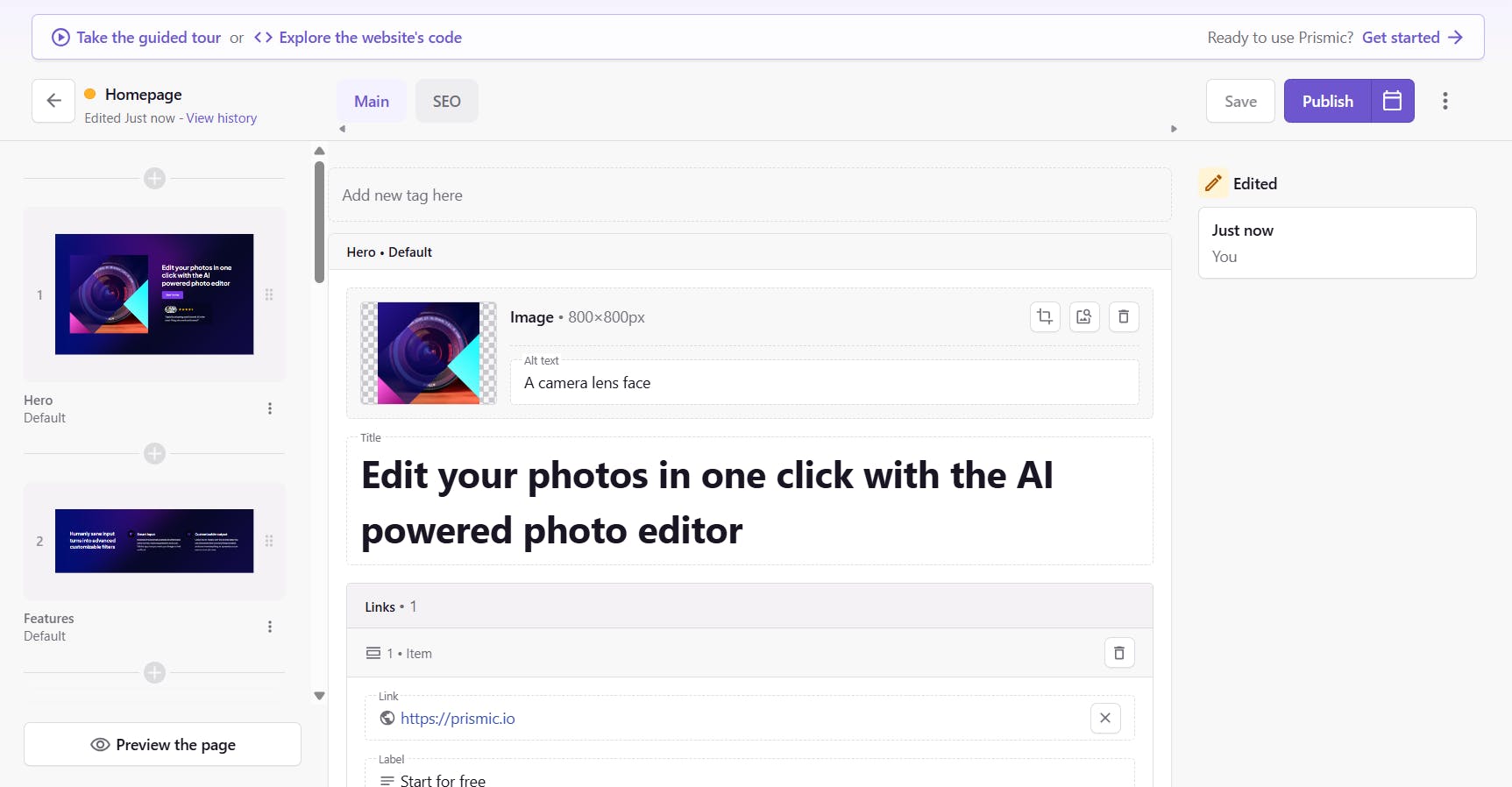
- SEO metadata assistant: Automatically suggests optimized meta titles and descriptions for every page, while flagging character count issues so your content stays within recommended limits for search. It also includes an inline preview of how your metadata will appear in search results, reducing guesswork for content teams.
- Fast APIs and CDN-backed content delivery: Prismic's API is backed by a global CDN, delivering content in milliseconds regardless of where users are located. Faster content delivery directly improves page load times, which is a ranking factor for both traditional search and Core Web Vitals.
- Built-in image optimization: Through a partnership with Imgix, Prismic automatically compresses and optimizes images and delivers them in next-gen formats. Since images account for a significant portion of a webpage's weight, this has a direct impact on page performance and SEO.
- Auto-generated SEO metadata tabs: When a page type is created in Slice Machine, an SEO and metadata tab is automatically generated. This provides a consistent, simplified way to manage metadata across every page without relying on developers.
- Simplified internal linking: The Page Builder lets content teams add internal links between related pages without developer involvement, which helps strengthen your site’s structure and topical authority over time.
Boost Your SEO with Prismic
Learn more about how Prismic can improve your SEO performance.
Limitations
- The Slice-based content architecture can take time to fully grasp, especially for teams new to component-driven content modeling.
- Prismic is optimized for web and landing page use cases, so it isn't the perfect match if you need to deliver content across multiple channels from a single headless CMS.
Pricing
- Free
- Starter ($10/month)
- Small ($25/month)
- Medium ($150/month)
- Platinum ($675/month)
- Enterprise (Custom)
Resources
2. Ghost
Best for: out-of-the-box SEO without complex technical setup
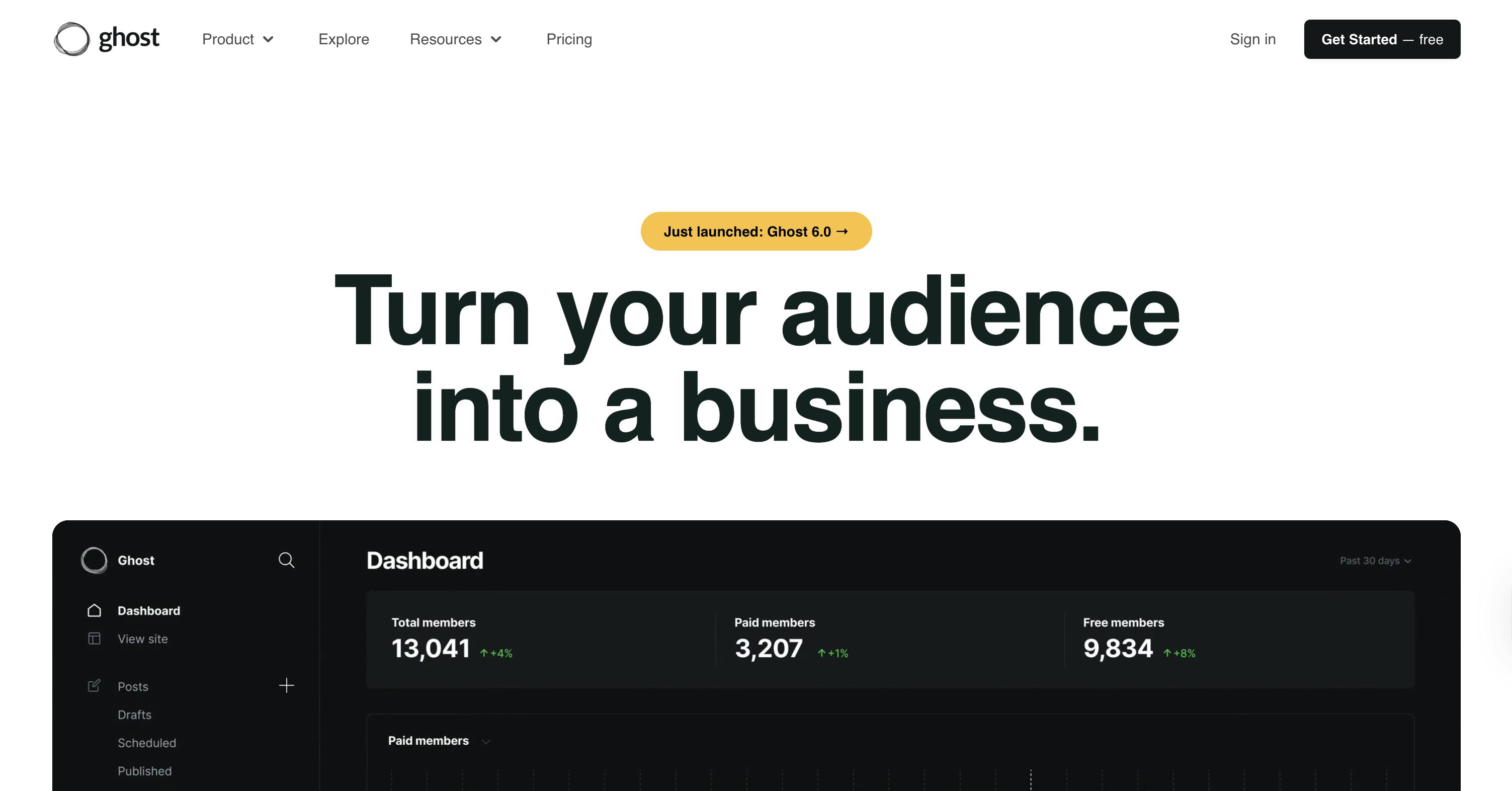
Ghost is an open-source publishing platform built for professional content creators, publishers, and independent media businesses. It combines a website, newsletter, and membership platform into a single tool, and is popular for creators who want to build and monetize an audience without relying on third-party platforms.
SEO strengths
- Automatic metadata: Ghost generates metadata for every post and page automatically. If editors leave the fields blank, it pulls from available content as a fallback, so no page goes live without basic SEO coverage.
- Social media metadata: Twitter Cards and Open Graph tags are built in, so your content is properly formatted when shared on social platforms without any extra setup.
- Automatic XML sitemaps: Ghost creates and updates your XML sitemap as you publish, keeping search engines informed about your site structure without any manual work.
- Canonical tags: Canonical tags are added automatically across the site, which prevents duplicate content issues by telling search engines which version of a page is the authoritative one.
- Structured data: Every post and page includes structured data out of the box, helping search engines understand your content and potentially improving how it appears in results.
Limitations
- Ghost's pricing is audience-based, meaning costs grow as your subscriber count increases, which can get expensive over time.
- It is built primarily for content publishing, so teams that need complex content structures beyond blog posts and pages will find its content modeling capabilities limiting.
- It is not well-suited for large teams or enterprise use cases that require advanced workflows or multi-brand content management.
- While Ghost handles SEO well for content-driven sites, it offers less technical SEO customization than other headless CMSs, where developers have more control over structured data and metadata.
Pricing
- Free (self-hosted)
- Starter ($15/month)
- Publisher ($29/month)
- Business ($199/month)
- Custom (Custom).
Note: Ghost’s pricing structure is audience-based, so you pay more as your audience grows.
Resources
3. Payload
Best for: developer-first SEO controls
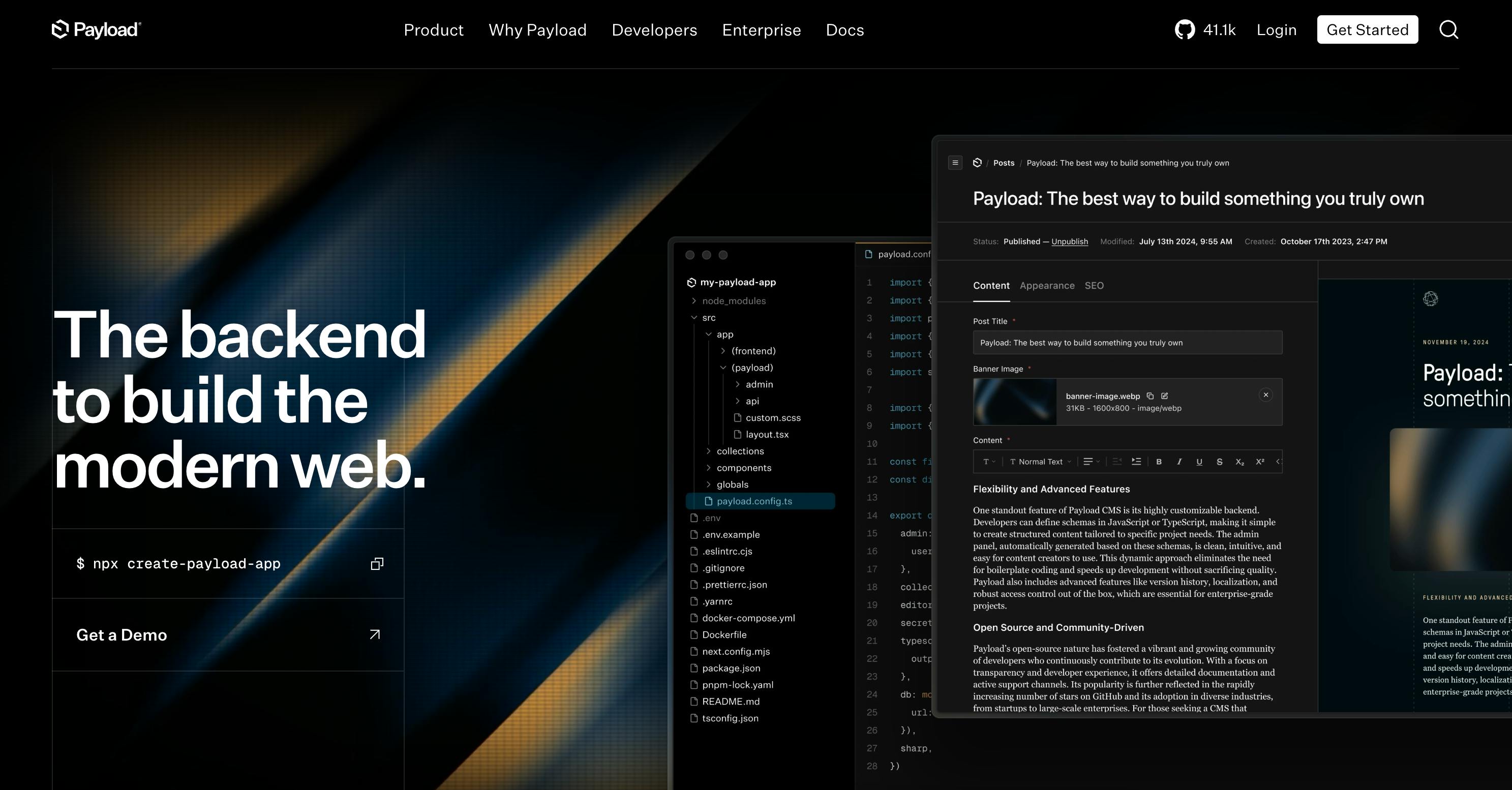
Payload is open-source and positions itself as a SEO-native headless CMS that helps you organically position your content for maximum reach.
SEO strengths
Payload has a dedicated SEO plugin that brings metadata management straight into the admin panel. Once enabled across your content types, editors can manage meta titles, descriptions, and images for every piece of content.
Here's what the plugin can do:
- Auto-generate metadata from your existing content, pulling the page title or using a summary of the page as the meta description.
- Generate meta images by integrating a third-party API, including AI image generation tools.
- Real-time search preview that shows editors how a page will appear in search results as they type.
- Character counters and visual indicators to guide editors while they write meta.
- Custom field injection so you can add fields like og:title or JSON-LD structured data directly into the meta field group.
- Auto-generate functions that you can fully customize per collection, giving each content type its own metadata logic.
Limitations
- The SEO plugin requires heavy developer involvement to set up and get the most out of it, meaning that non-technical teams cannot get started on their own.
- Payload is self-hosted, which means you are responsible for managing your own infrastructure, which adds both cost and technical overhead.
Pricing
Free (Open source)
Resources
4. Strapi
Best for: a plugin-driven approach to managing SEO
Strapi, an open-source headless CMS, gives developers full control over their content architecture. It is API-first, supports both REST and GraphQL out of the box, and is a popular choice for teams that don’t want to be locked into a proprietary system.
SEO strengths
- Flexible metadata management: You can create custom fields for meta titles, descriptions, and keywords at the content model level, meaning every product page or content entry can have tailored SEO metadata.
- Structured data support: Strapi supports JSON-LD structured data implementation, allowing you to add schema markup for content types like products, reviews, and FAQs.
- SEO-related plugins: There are many plugins you can use—via Strapi's marketplace—to extend its SEO capabilities, such as the official SEO plugin, for managing metadata.
Limitations
- Choosing Strapi’s self-hosted options means your team is responsible for infrastructure, hosting, and performance optimization.
- There’s no simple login-and-go experience with the self-hosted route. Setting up the CMS requires running scripts, configuring your environment, and working through a technical setup process before your content team can even get started.
- Getting the most out of Strapi's SEO setup requires significant developer involvement, from configuring metadata components to making sure your frontend renders SEO fields correctly.
Pricing
- Community (Free)
- Growth ($45/month)
- Enterprise (Custom)
Resources
5. Kontent.ai
Best for: content audits and SEO improvements with AI agents
Kontent.ai uses AI agents to automate tasks like audits, governance, and localization, and describes itself as an “Agentic CMS,” where automation handles the busywork so teams can focus on strategy and creativity.
SEO strengths
- Content freshness and audit tools: You can schedule automatic expiration for time-sensitive pages, track version history, and archive content that no longer serves your audience. For large teams managing content at scale, that kind of visibility improves content hygiene, which in turn can boost organic performance.
- AI-powered SEO and GEO optimization: Kontent.ai uses AI agents that automatically scan your entire content inventory for SEO and GEO gaps, recommend fixes, and apply them at scale. From missing metadata and weak content structure to incomplete alt text and inconsistent taxonomy, the platform detects and resolves these issues without requiring SEO specialists or developer involvement.
Limitations
- Kontent.ai sits at a higher price point compared to most headless CMS platforms, making it less accessible for smaller teams or budget-conscious projects.
- The onboarding process has a steep learning curve, particularly for teams that are not familiar with enterprise content workflows and content modeling concepts.
Pricing
Available on request
Resources
6. Storyblok
Best for: AI-search monitoring
Storyblok positions itself as a “headless CMS made for humans, built for the AI-driven content era.” It combines an API-first, component-based architecture with a visual editor that lets marketers and editors create and manage content without developer support.
SEO strengths
- SEO app: Adds a meta tag field group directly to any block in your content model. Once installed, editors can manage standard meta tags like title and description, Open Graph tags for social sharing, and preview how a page will appear in Google search results before it goes live.
- AI search readiness and GEO optimization: Storyblok structures your content into organized, nestable blocks that AI engines can crawl, understand, and pull from when generating answers.
- AI SEO plugin: Analyzes your content and generates optimized metadata with a single click, all with zero manual research. It also flags missing or underperforming elements before they become search engine issues.
- Content observability: With its integration with OtterlyAI, Storyblok lets you track how your content performs across AI-driven search platforms. You can see when and where your content is being cited, spot gaps where your brand is missing from AI answers, benchmark against competitors, and run GEO audits to understand what is driving or limiting your visibility.
Limitations
Compared to other platforms, Storyblok's plugin ecosystem is relatively limited, which can be an issue for teams that rely heavily on third-party integrations to extend their CMS functionality.
Pricing
- Starter (Free)
- Growth (€90.75/mo)
- Growth Plus (€319.91/mo)
- Premium & Elite (Custom)
Resources
7. Contentful
Best for: enterprise-scale SEO management
Contentful is a headless CMS built around a composable, modular content architecture and is favored by enterprise teams looking to create content once and deliver it across any channel or region.
SEO strengths
- AI and search engine optimization: Contentful's structured content modeling makes it easier for both search engines and AI systems to interpret and surface your content. Reusable content elements let you spin up dynamic landing pages at scale without duplicate content risks, and fast page delivery helps teams hit strong Core Web Vitals scores.
- SEO apps via marketplace apps: Contentful's marketplace includes SEO-focused apps that extend its optimization capabilities, such as the AltText AI tool that automatically generates alt text for images.
- AI Actions for SEO automation: Contentful's AI Actions streamline repetitive SEO tasks like generating alt texts, meta descriptions, FAQs, and language translations.
Limitations
- Contentful is more expensive than most headless CMS alternatives, which can be a barrier for teams working with tighter budgets.
- Contentful Studio, AI Actions, and personalization are locked behind paid add-ons that are only available on premium custom plans—the most expensive tier—to begin with.
- The platform is built with large organizations in mind, so smaller teams or projects with straightforward content needs may find it more powerful than they actually need because of the feature overload.
Pricing
- Free
- Lite ($300/month)
- Premium (custom pricing)
Resources
How to choose a headless CMS for SEO in 2026
There are standard considerations that apply when it comes to using a headless CMS, such as pricing, ease of use, and the developer experience. While those are important, there are other factors at play when SEO and GEO are a priority for your operations. These include:
- Metadata control: Can you define and manage custom meta titles, descriptions, canonical URLs, OG tags, and hreflang attributes at the content model level, without hardcoding them in your frontend?
- Schema & structured data flexibility: How easily can you model content that maps to schema.org types (Article, Product, FAQ, BreadcrumbList, etc.)? Also, does the CMS support this natively, or does it require heavy frontend workarounds?
- Localization & hreflang support: For multi-region or multilingual sites, does the CMS handle locale management in a way that makes hreflang implementation clean and maintainable?
- Image optimization pipeline: Does the CMS have built-in image transformation, compression, and next-gen format delivery (WebP, AVIF)? Images are still a major LCP culprit.
- Sitemap & robots.txt control: Can you generate and manage sitemaps programmatically from your content model? Do you have full control over robots.txt without going through a developer every time?
- GEO & AEO Readiness: Is the content structured in a way that AI platforms can parse your content for visibility across platforms like Perplexity and ChatGPT?
SEO vs. GEO vs. AEO
The emergence of AI-driven discovery channels has introduced new terminology, including GEO and AEO. Here’s a breakdown of how they compare with SEO.
- SEO (Search Engine Optimization) is the foundation most teams are already familiar with. It involves optimizing content and technical infrastructure to rank in traditional search engines like Google and Bing. SEO still matters in 2026, but it is no longer the whole picture for visibility.
- AEO (Answer Engine Optimization) focuses on structuring content so it gets directly cited within AI-generated answers, knowledge panels, and featured snippets. The goal is to become an authoritative, accurate answer to queries.
- GEO (Generative Engine Optimization) takes a broader view. Rather than optimizing purely for text-based answers, GEO is about publishing deeply researched, authoritative content that AI systems can draw on when synthesizing responses across text, image, and video formats. It is less about one specific output and more about becoming a trusted source that generative systems reference.
The space is still very much developing, so naturally, new terms keep emerging. The industry is yet to agree on a single term that fully captures what it means to optimize for AI-driven discovery.
Recap and next steps
Choosing the right headless CMS is one of the most important infrastructure decisions you can make for your organic growth strategy.
In this guide, we covered the platforms that give you the strongest foundation for SEO and AI search visibility in 2026, from flexible content modeling and metadata control to structured data support, page speed, and GEO readiness.
Not every platform will be the right fit for every team, but the options covered here all offer meaningful advantages over traditional CMS platforms when it comes to search performance.
If you are looking for a headless CMS that is built specifically for SEO and AI search visibility, Prismic is a great place to start. With its AI-powered landing page builder, built-in image optimization, automatic metadata management, and Slice-based content modeling, Prismic gives both developers and content teams everything they need to scale organic visibility and show up where their audience is searching.