Why your content ranks on Google but AI never cites it (and how to fix it)


TL;DR
- Ranking and citation are separate systems, and they have pulled apart fast. The share of AI Overview citations coming from top-10 pages has fallen from roughly 76% to somewhere between 17% and 38%, depending on whose study you read.
- Before rewriting anything, rule out four things: crawler access, JavaScript rendering, snippet directives, and whether the question you are losing produces sourced answers at all.
- Some pages were never in the running. In our own 30-day test, Microsoft Copilot answered 76.19% of how-to prompts without citing a single source.
- Two of the most-repeated fixes have now been tested and do nothing: llms.txt and chunking. Schema turned out to be more interesting than either camp claims.
- The advice that survives scrutiny is unglamorous: be readable by machines, put your facts where they can be seen, use the words your buyers use, and keep the page current.
You ran your own target question through ChatGPT last week and watched it recommend three competitors you outrank on Google. Search Console looks healthy. Impressions are up, if anything. So you went looking for an explanation and found a dozen articles telling you to add schema, publish an llms.txt file, and break your content into small chunks. Since those articles were written, all three have been tested, and the results are not what they promised. This piece takes a different approach: every fix below carries a label saying how much evidence sits behind it, including the ones where the honest answer is "not much, but the reasoning holds."
Why ranking on Google and getting cited by AI stopped being the same job
They are different jobs because they answer different questions. A search engine returns a ranked list of pages for the query you typed. An AI answer is assembled from passages pulled in to satisfy a question the system generated itself, which may not be the question you optimised for.
Google calls this query fan-out, and documents it plainly: a single user question becomes a set of related sub-questions, each fetching its own results. A page that wins one keyword can be absent from the pool that answers the actual question.
The data on how far apart the two have drifted is genuinely contested, and it is worth seeing that rather than being handed a single number. In mid-2025, Ahrefs found 76% of AI Overview citations came from pages ranking in the top 10, with a median position of four. By February 2026, Ahrefs put the figure at 38% while BrightEdge, using a different dataset and method, put it near 17%. Moz found 88% of AI Mode citations came from outside the top 10.
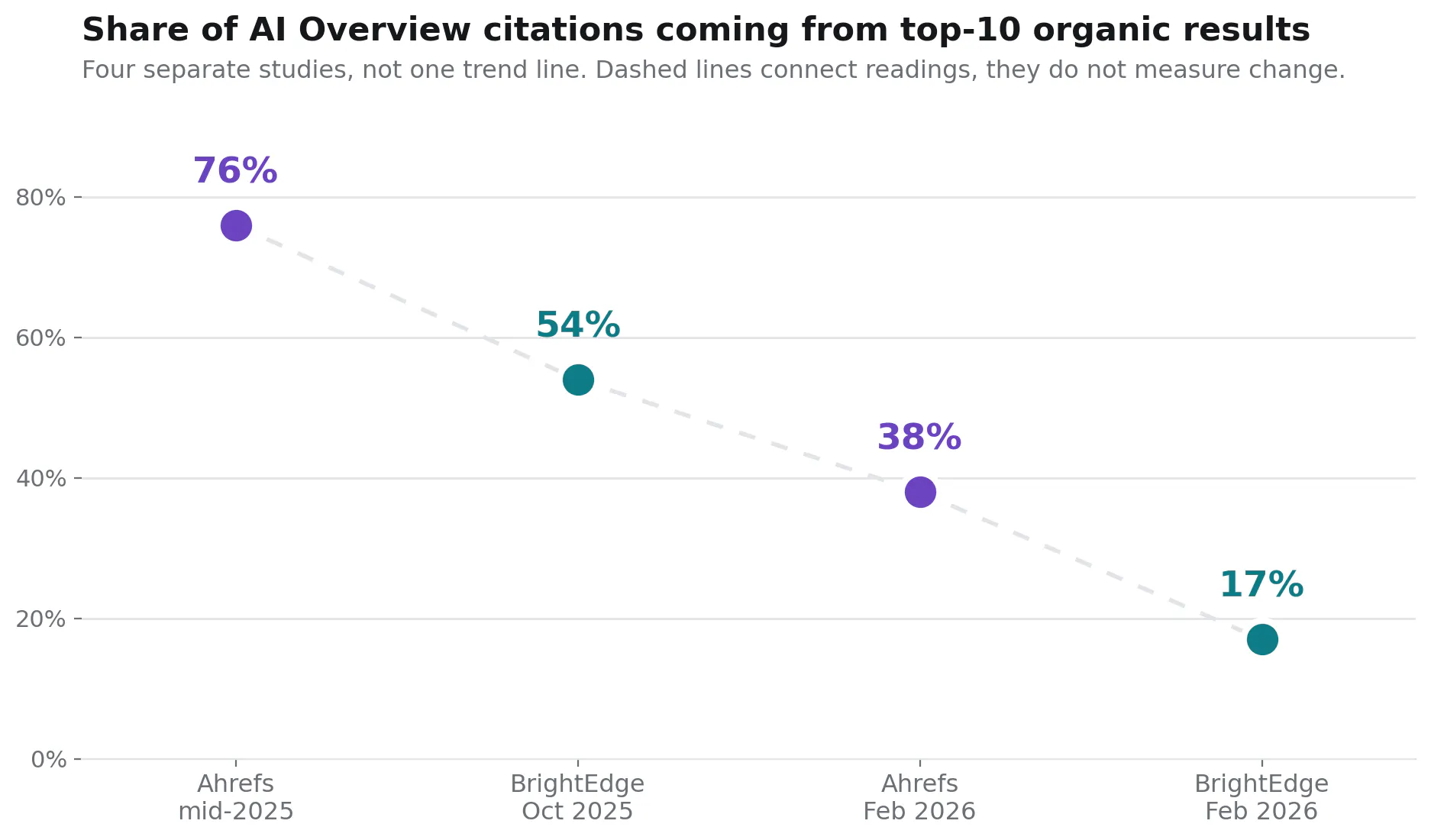
Those studies were run on different query sets in different months by teams measuring slightly different things. The only safe conclusion is directional: the overlap has narrowed, sharply, and quoting any one of those numbers as fact is how this topic became so noisy.
Your sector matters before you panic. BrightEdge's 16-month analysis found healthcare, insurance and education still showing 68% to 75% overlap between citations and top-10 rankings, while ecommerce barely moved at all.
Rankings have also not stopped mattering. A 2026 preprint by Kurt Fischman, worth reading with its limits in mind since it is unreviewed and covers 1,006 pages, found organic position was the strongest predictor of citation once the statistical artefacts were stripped out. Pages at position one were cited in 43% of the queries where they appeared. By position seven, that was 5%.
Four reasons AI might not cite your content despite ranking on Google
Rule these out before you rewrite anything. They are binary, checkable in minutes, and a page that fails any of them cannot be cited no matter how well it is written. The first three follow the request: can the crawler reach the page, can it read the page when it arrives, and are you letting it reuse what it read. The fourth has nothing to do with your page at all.
1. Can the crawler reach the page?
Three things can stop an AI crawler from seeing your page, and only the first one is visible to you.
robots.txt turns crawlers away by asking. A disallow on GPTBot or ClaudeBot is respected by the crawlers that follow the standard, which is most of the ones that matter. It is also the only block someone chose on purpose, usually back when the worry was training data rather than search traffic.
Your CDN turns them away by force, before the request ever reaches your site. Cloudflare, Akamai, Fastly and AWS all offer a setting that refuses AI crawlers as a group, and some have it on by default. Nothing about it shows up in robots.txt, and the page still loads perfectly for you, because you are not the one being refused.
Your own site can refuse them too. It might limit how many pages a single visitor can request at once, which a crawler working through your site trips immediately. It might show a "checking your browser" screen, which you clear without noticing and a crawler cannot. Or the page sits behind a login. In each case something comes back. Your content does not.
HasData's July 2026 index of 10,894 domains shows how often this happens. Asking from the same address, they got the page 83.8% of the time as a normal browser and 54.2% of the time as GPTBot. Same request, same page, one difference: who was asking.
Which crawler is blocked decides what you lose, and they do not overlap. GPTBot and OAI-SearchBot feed ChatGPT. Google AI Overviews runs on Googlebot, so blocking OpenAI costs you nothing there. Copilot leans on Bing's index, so blocking Bingbot removes you from a product that never mentions Bing.
What you can check yourself: read robots.txt. Ten seconds, and any AI crawler disallow sitting in there was a decision someone made before AI search sent anyone traffic. Worth asking whether it still holds.
What to ask for: send whoever owns your CDN account this question. Over the last 30 days, what responses did GPTBot, OAI-SearchBot, ClaudeBot, PerplexityBot and Googlebot get from our site, and are any AI crawler settings switched on? If those crawlers were getting the page, this is not your problem. If they were being turned away, that is your whole answer, and it is a settings change rather than anything to do with your writing.
2. Can it read the page when it arrives?
Most AI crawlers do not run JavaScript. If your content is painted onto the page after load, they see an empty shell.
Vercel and MERJ analysed over 500 million GPTBot fetches and found no evidence of JavaScript execution at all. GPTBot downloads JavaScript files in about 11.5% of requests and ClaudeBot in about 23.8%, and neither runs them. Google's Gemini is the exception, because it inherits Google's rendering infrastructure.
There is a nuance worth knowing before you treat this as fatal everywhere. That data covers crawlers fetching a page in the moment. Systems that answer from a search index rather than a live fetch can still pick up client-rendered content, because the crawler that built the index does render it. In searchVIU's test, both Google AI Mode and Perplexity found a JavaScript-inserted price once the page had been indexed, having missed it entirely before.
So client-side rendering is fatal for live retrieval and merely risky elsewhere. To check, open the page with view-source rather than in the browser and look for your body copy in the raw HTML. Search Console's URL inspection will not tell you this, because it shows what Googlebot sees, which is a different pipeline. If the copy is missing, the ask for your developer is that the main content be present in the first HTML response. Our guide to React SEO considerations and solutions covers what that change involves.
3. Are you letting it reuse what it read?
Google states that to appear in its generative AI features, a page must be indexed and eligible to be shown with a snippet. So nosnippet, max-snippet:0 and data-nosnippet disqualify it. Plenty of sites added those directives years ago to deter scrapers and never revisited the decision.
One Google-specific footnote. Google has begun rolling out a Search Console control that excludes a property from AI Overviews and AI Mode. Inclusion is the default and the setting is only live for some accounts, so this is rarely the cause. But if anyone on your legal or publishing side opted out, that is the entire answer, and checking takes ten seconds.
Reach and read apply to every engine. This third one covers Google only.
4. Is the content destined to be swallowed by the AI's internal knowledge?
Some questions never send the model looking for a source. It answers from what it already learned, so no page wins because no page was retrieved. Yours was not passed over. It was never in the room.
In our 30-day AI search visibility experiment, Microsoft Copilot answered 76.19% of how-to prompts without citing anything, and 29.23% of all prompts across the set. Google AI Overviews cited nothing in 7.69% of runs. ChatGPT and Perplexity cited sources every time.
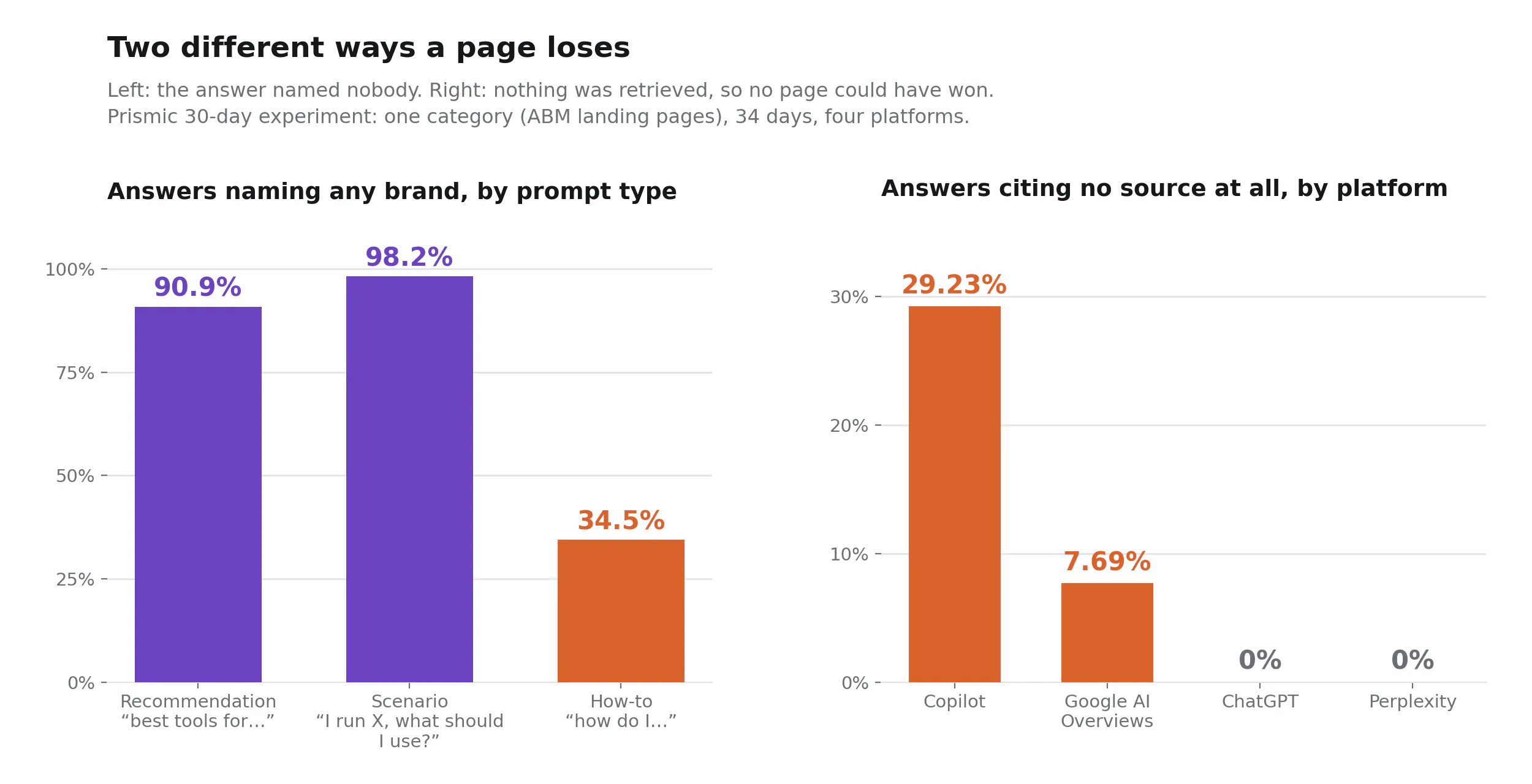
The line runs along the funnel. Decision-stage questions get sourced and named, because the model is curating and curation means producing options. Informational questions get explained, and teaching needs no vendors. A brand appeared in 90.9% of our recommendation answers against 34.5% of how-to answers.
That was one category over 34 days, so the percentages are ours. Run your question and check two things: does the answer cite sources, and does it name anyone.
The fixes that actually get your content cited by AI, and how much confidence each deserves
These fixes are categorized into three labels:
- Tested means a controlled experiment or explicit platform documentation.
- Observed means a large-scale correlation where the cause is unproven.
- Reasoned means it follows from how these systems work, but nobody has tested it directly.
Fix 1: Answer the exact question in the first two sentences (reasoned, with one supporting experiment)
This is the most common advice on the topic and the evidence for it is thinner than its popularity suggests.
What exists is the Princeton-led study presented at KDD 2024, which tested nine content changes across 10,000 queries. Adding statistics, source citations and quotations each raised visibility by 30% to 40% on its main metric. Keyword stuffing produced a negative result.
The counterweight arrived a year later. C-SEO Bench, presented at NeurIPS 2025, retested this class of tactic across six domains and, crucially, under conditions where multiple sites adopt it at once. Most methods were ineffective or actively harmful. Gains converged toward zero as adoption rose, and a plain retrieval-ranking baseline outperformed the best tactic by roughly 7.6 times in their retail measurement.
Two peer-reviewed papers, opposite conclusions. The difference between them is competition. Early movers gained; once everyone writes this way, the advantage disappears and only genuine relevance is left. Structure your pages this way because it makes them better, not because it is a lever.
Fix 2: Put your facts where they can be seen (tested)
If a number matters to a buying decision, it needs to be visible on the page, not tucked into markup.
searchVIU built a test page with product prices hidden in different places and asked five AI systems what things cost. Not one of them found the price that existed only in JSON-LD, even though it appeared nowhere else. ChatGPT and Gemini did find the prices marked up in visible Microdata and RDFa, because those sit inside content a person can see.
This is the cheapest fix on the list and the most commonly skipped. Pricing, specifications, ratings, limits, supported integrations: if a competitor's page states them plainly and yours implies them, the competitor gets quoted.
Fix 3: Use the words your buyers use, and use the same ones every time (tested)
AI systems search two ways at once. One pass matches meaning, so it handles synonyms well. The other matches the literal words on the page, which is what carries the query for product names, model numbers, version strings and specialist terms that meaning-matching handles poorly. The results from both are then merged.
The practical version: if your buyers say "ABM landing page builder" and your site says "account personalisation platform", you are relying entirely on the half of the system that is weakest at proper nouns. Pedro Dias, formerly of Google's Search Quality team, explains the mechanism in detail.
The same logic makes stylistic variation expensive. Calling something a content model in one paragraph and a schema structure in the next splits a signal that would have been stronger left alone.
Fix 4: Give one page one job (reasoned, mechanism-backed)
Retrieval systems adjust for length, so a focused page answering one question can beat a long page covering twenty. The long page dilutes its own relevance across topics nobody asked about.
This is not chunking, and the distinction matters. Google states explicitly that there is no requirement to break content into small pieces, and that its systems can surface the relevant part of a page covering several topics. The defensible idea is about page scope, not paragraph size. Split a sprawling guide into pages that each answer one question and link them together. Do not reformat the sprawl into smaller paragraphs and expect anything to change.
Fix 5: Keep the page current (observed)
Ahrefs analysed 16.975 million cited URLs across seven platforms. Pages cited by AI averaged 1,064 days old against 1,432 days for pages in organic results, making cited content about 25.7% fresher. ChatGPT showed the strongest preference for recent pages.
Ahrefs frame this as a citation pattern rather than a causal multiplier, and that framing should survive into your planning. Fresher pages get cited more; updating a page does not mechanically produce citations. Changing the date on an unchanged page is not a refresh, and nothing in the data suggests it works.
Fix 6: Get talked about elsewhere (observed, and the weakest causal claim here)
Ahrefs measured 75,000 brands against AI Overview visibility. Branded web mentions correlated at 0.664, branded anchor text at 0.527, brand search volume at 0.392, and referring domains at just 0.218.
Ahrefs state the caveat themselves and it is a real one: large brands have both more mentions and more visibility, so brand strength may be doing all the work.
There is also a counterweight worth knowing before you redirect budget into digital PR. In our 30-day test, content authored by companies in the category took roughly 70% to 75% of all citations, ahead of publishers and social platforms, across every prompt type. Your own pages are where this starts. Google also lists seeking inauthentic mentions among the things that do not help.
What doesn't work, and what has never actually been tested
Tested, and it did not do what people claim
Schema markup is more interesting than either side of the argument admits. Ahrefs tracked 1,885 pages that added JSON-LD against 4,000 matched controls. AI Mode moved 2.4% and ChatGPT 2.2%, both statistically indistinguishable from zero. AI Overviews fell 4.6%, which is real but works out at around 12 daily citations on pages receiving hundreds, and both the treated and control groups were already declining beforehand for reasons nobody could isolate.
Two limits before reading that as "schema is dead". Every page in the sample already had 100 or more AI Overview citations before schema was added, so the study says nothing about a page that is not yet visible. And rich results remain a perfectly good reason to keep it.
The useful conclusion comes from putting that study beside two others. searchVIU found no system reads JSON-LD at fetch time, while Fischman found pages carrying Product or Review schema populated with real prices and ratings were cited 61.7% of the time against 41.6% for generic Article or Organization markup. The facts do the work, not the markup wrapped around them. Structured data that mirrors information already visible on the page is fine. Structured data used as a hiding place for information you never published is read by nothing.
On llms.txt, Ahrefs checked 137,000 sites and found 97% of llms.txt files received zero traffic in May 2026. More tellingly, AI bots never went looking for the file on domains that did not have one. Google's Search systems ignore it. There is a real use case, which is AI coding assistants pulling product documentation, and that is worth knowing if you sell to developers.
On chunking, Google's documentation states there is no requirement to break content into tiny pieces and no ideal page length. Rewriting for AI and buying mentions both appear by name in Google's mythbusting section.
One boundary on all of the above: where the source is Google's guide, the finding covers Google Search. ChatGPT, Claude and Perplexity publish no equivalent documentation, so nothing here settles the question for them.
Repeated everywhere, never tested
Untested is not the same as false. The following are plausible, may well be true, and have no published study behind them.
That AI weights the first screen of a page heavily. That author bylines and stated credentials drive citation. That broad, unqualified claims are risky to reuse and get skipped. That sections should run 100 to 300 words, a figure repeated across dozens of articles with no methodology attached to any of them.
The pattern behind these is worth naming. The highest-ranking articles on this exact question tend to present six or seven confident reasons without citing a single study, and the advice gets repeated until it sounds settled. Most of it is sensible writing craft. The problem is the confidence, not the content. Do these things if they make your pages better. Do not build a quarter around them.
A diagnostic for a page that ranks but never gets cited
Work in this order. It runs from fastest to most involved, which puts the prompt check first even though it came last above.
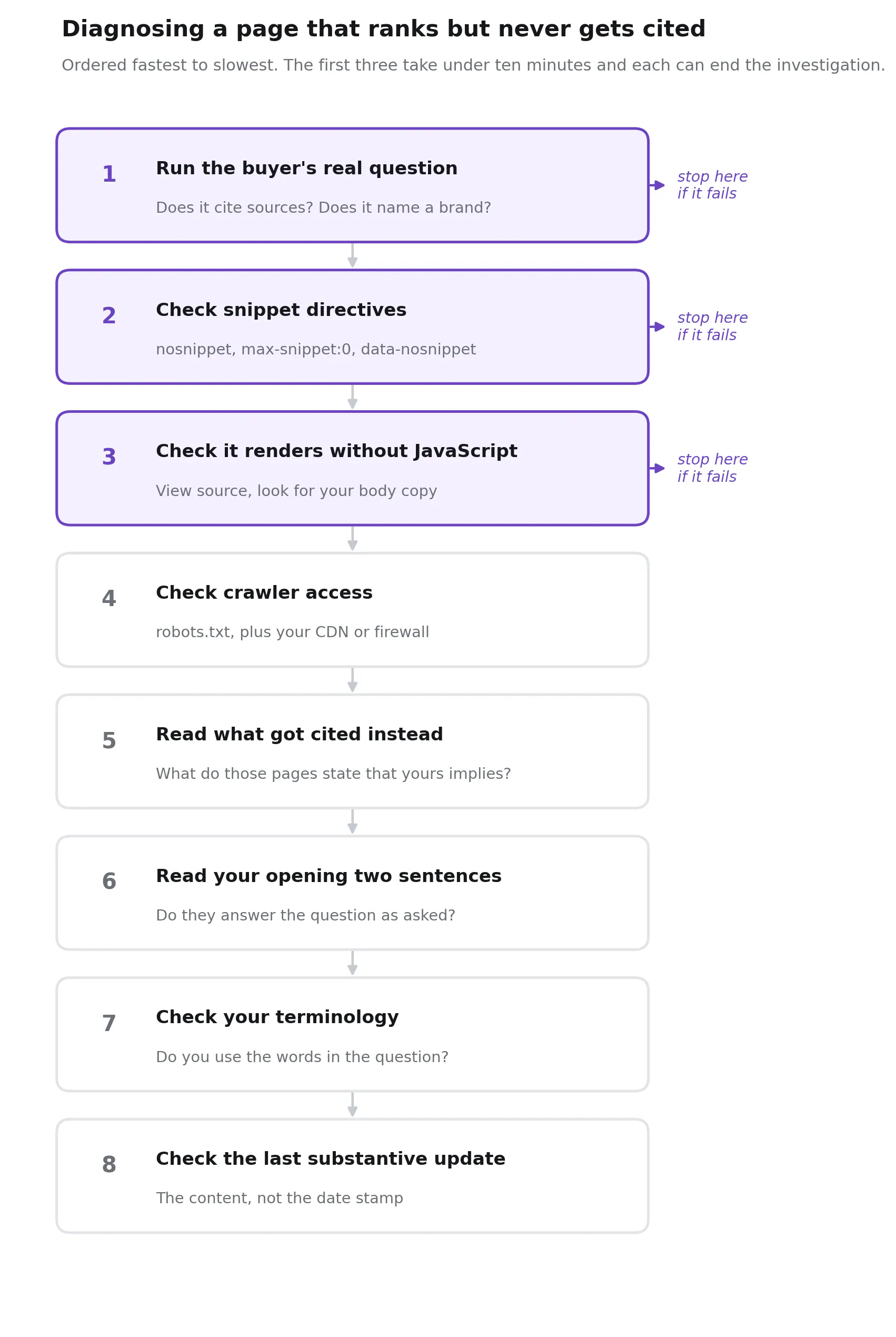
- Run the buyer's actual question on ChatGPT, Perplexity and Google AI Overviews. Check two things: does the answer cite any sources, and does it name any brand. If it cites nothing, the model answered from memory and no page could have won. If it cites sources but names nobody, the question is informational and brand mentions were never on offer. Either way, stop.
- Check your snippet directives. View source and search for
nosnippetandmax-snippet. If either is present, stop and remove them. - Check the page renders without JavaScript. View source and look for your actual body copy. If it is missing, stop. This is your whole problem.
- Check crawler access in robots.txt and with whoever runs your CDN or firewall.
- Look at what got cited instead. Open every source the answer used. You are looking for what those pages do that yours does not: usually they answer the specific question earlier, or they state a concrete fact your page only implies.
- Read your opening two sentences as if you were the person who asked the question. If they do not answer it, that is the edit.
- Check your terminology against the words in the question. If the answer says "landing page builder" and your page says "campaign infrastructure", fix the vocabulary before anything else.
- Check the last substantive update. Not the date stamp: the content.
Once you know which of these is your problem, our guide to optimizing content for AI search engines covers the rewriting work in detail.
Final Note: prompt tracking should be the first thing you set up, not the last
Everything above depends on knowing which question you are losing. Without that, you are diagnosing a page you picked by instinct, which is how teams end up rewriting their best guide while the actual gap sits on a comparison page nobody assigned.
Start with a read of where you actually stand. Our free GEO audit runs your category's questions across ChatGPT, Gemini and Claude and shows which prompts you appear in, which competitors take instead, and what gets cited in your place. Then keep asking the same questions on a schedule, whether with that or anything else, because the answer next month will not be the answer today.
Turn a prompt you are losing into a page
See how teams go from a list of prompts they are losing to published pages that answer them, without a developer in the loop. We will walk through your own category's questions on the call.
Frequently asked questions
Keep reading