
TL;DR
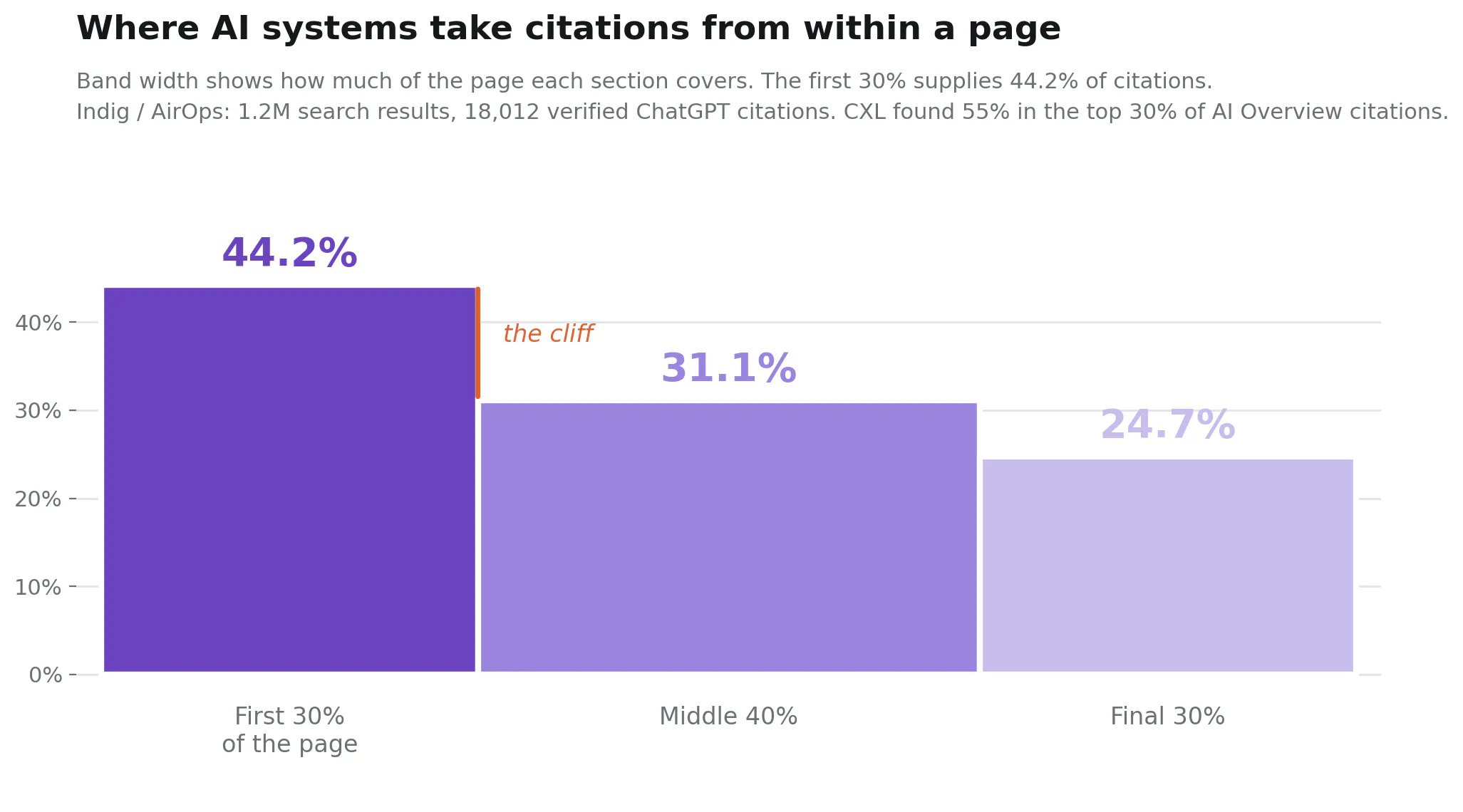
- Extraction is front-weighted. 44.2% of ChatGPT citations come from the first 30% of a document, and burying a definition deeper cuts its retrieval chance by roughly 2.5x.
- Fix the technical layer before you rewrite anything. A page a crawler cannot reach or read cannot be cited, no matter how well it is structured.
- Prioritise decision-stage pages. A brand appeared in 90.9% of answers to recommendation prompts in our own test, against 34.5% of how-to answers.
- Page length is close to irrelevant. Across 174,048 pages, the correlation between word count and citation was 0.04, and 53.4% of cited pages were under 1,000 words.
- Several of the most-repeated tactics have now been tested and do nothing: schema markup, llms.txt, and chunking your content into small blocks.
Most guides on this topic give you the same eight pillars, and almost none of them cite a study. That was tolerable a year ago when nobody had data. It isn't now: 2026 produced several large citation datasets, and some of what they found contradicts the standard advice outright. This is a sequence for optimizing content you already have, ordered by dependency. The order matters more than any single tactic in it, because three of the steps are wasted effort if the one before them isn't done.
What AI search engines actually extract from a page
AI systems don't cite pages, they cite passages, and they take them overwhelmingly from the top of a document.
Kevin Indig's analysis of 1.2 million search results and 18,012 verified ChatGPT citations found that 44.2% of citations came from the first 30% of a document, 31.1% from the middle, and 24.7% from the final third. He describes the shape as a ski ramp: a steep cliff after the first third, then a long, slow tail. CXL's independent study of 100 pages found 55% of AI Overview citations came from the top 30%. Two different systems, two different datasets, the same structural bias.
Indig puts a number on the cost: burying a key product feature or definition deep in the content reduces retrieval probability by a factor of 2.5 compared to putting it in the introduction.
There is a step before extraction that matters just as much and gets discussed far less. Before any model reads your page, a main-content extractor strips the navigation, footer, sidebar and ads. These are heuristic tools, and imperfect ones. In the SIGIR 2023 benchmark of web content extraction algorithms, Mozilla's Readability scored a median of 0.970 and trafilatura averaged an F1 of 0.883, which means a real slice of content on real pages gets thrown away as boilerplate before anything else happens.
So there are two filters, not one. Your content has to survive the extractor, and then it has to sit near the top of what survives. Everything below follows from that.
How to optimize your existing content for AI search engines
Four steps, in dependency order.
Step 1: Fix the technical problems that make optimization pointless
Start here, because a page an AI crawler cannot reach or read will not be cited regardless of how it is written. Four checks, all of which take minutes:
Crawler access. Check robots.txt, then check with whoever runs your CDN or firewall. The blocking rule nobody remembers setting is more common than the one in robots.txt, and marketing teams usually cannot see it.
JavaScript rendering. Vercel and MERJ analysed over 500 million GPTBot fetches and found no evidence of JavaScript execution at all. If your content is painted onto the page after load, most AI crawlers see an empty shell. Open the page with view-source rather than in the browser and look for your body copy in the raw HTML.
Snippet directives. Google states that a page must be indexed and eligible to be shown with a snippet to appear in its generative AI features, so nosnippet and max-snippet:0 disqualify it.
Search Console settings. Google now offers a control that excludes a property from AI Overviews and AI Mode. Inclusion is the default, so this is rarely the cause, but it takes ten seconds to rule out.
If any of these fail, stop and fix it before reading further. Our guide to diagnosing a page that ranks but never gets cited covers the full version of this check, including how to test each one.
Step 2: Find the content worth optimizing
Don't start with your highest-traffic pages. Start with the pages where a citation would actually mean something, then narrow to the ones with a fixable problem. Here's what you should do:
- Run the prompts you want to win. Take the questions a buyer would actually ask and run them through Peec, Profound, or by hand across ChatGPT, Perplexity and Google AI Overviews. Log three things per prompt: whether any brand is named, whether you are, and which sources get cited.
- Then reverse-engineer the cited sources. This is the step most people skip and it is the most useful one. Open every URL the AI cited, and don't only read the page. Look at what else that site publishes on the topic. Cited formats cluster hard. If three of the five cited sources are comparison pages with a specification table, and your equivalent information is spread across a features page and two blog posts, you do not have a content gap. You have the right information in the wrong shape, which is a much cheaper problem to fix.
Our free GEO audit runs your category's questions across ChatGPT, Gemini and Claude and shows which sources are cited in your place, if you would rather not do this by hand. - Cross-reference Search Console. Filter the Performance report to position under 10 and sort by impressions. Then open the Generative AI report, under Performance, or by appending /ai to your Performance report URL if the menu entry hasn't reached your property yet. Export its Pages list. Any page in the first list and absent from the second ranks well and is not being retrieved into AI answers, which is the clearest possible signal that the problem is structural rather than topical.
Know the report's limits before you rely on it. It gives impressions, pages, countries, devices and dates. No clicks, no queries, no API, and no data before 18 May 2026. - Sort by intent, not by effort. AI answers name brands when the question implies a choice and mostly do not when it implies learning. In our 30-day AI search visibility experiment, a brand appeared in 90.9% of answers to recommendation prompts and 98.2% of scenario prompts, against 34.5% of how-to prompts. Comparison listicles took 51.27% of all non-homepage citations, more than every other format combined.
So work in this order: comparison, alternatives and "best X" pages first. Then scenario and use-case pages. Then product and pricing pages. Educational guides last, and judged on whether they get cited rather than whether they get you named.
A worked example, using this page. Over 90 days, this article took 143 impressions and zero clicks. Its head terms sat between positions 32 and 43, nowhere near a click. But fifteen long conversational queries sat at position 1 or 2, including "what sections of a blog post do ai models most often extract from?" It is a page that fails completely at ranking and succeeds completely at being retrieved. It is also educational, which is precisely why the retrieval success produces no recommendations. Both facts are visible in Search Console in about ten minutes, and which one describes your page determines which of the steps below matter.
Step 3: Optimize the page/structure it for AI retrieval
Here are the 6 changes you should make, roughly in the order you'd make them.
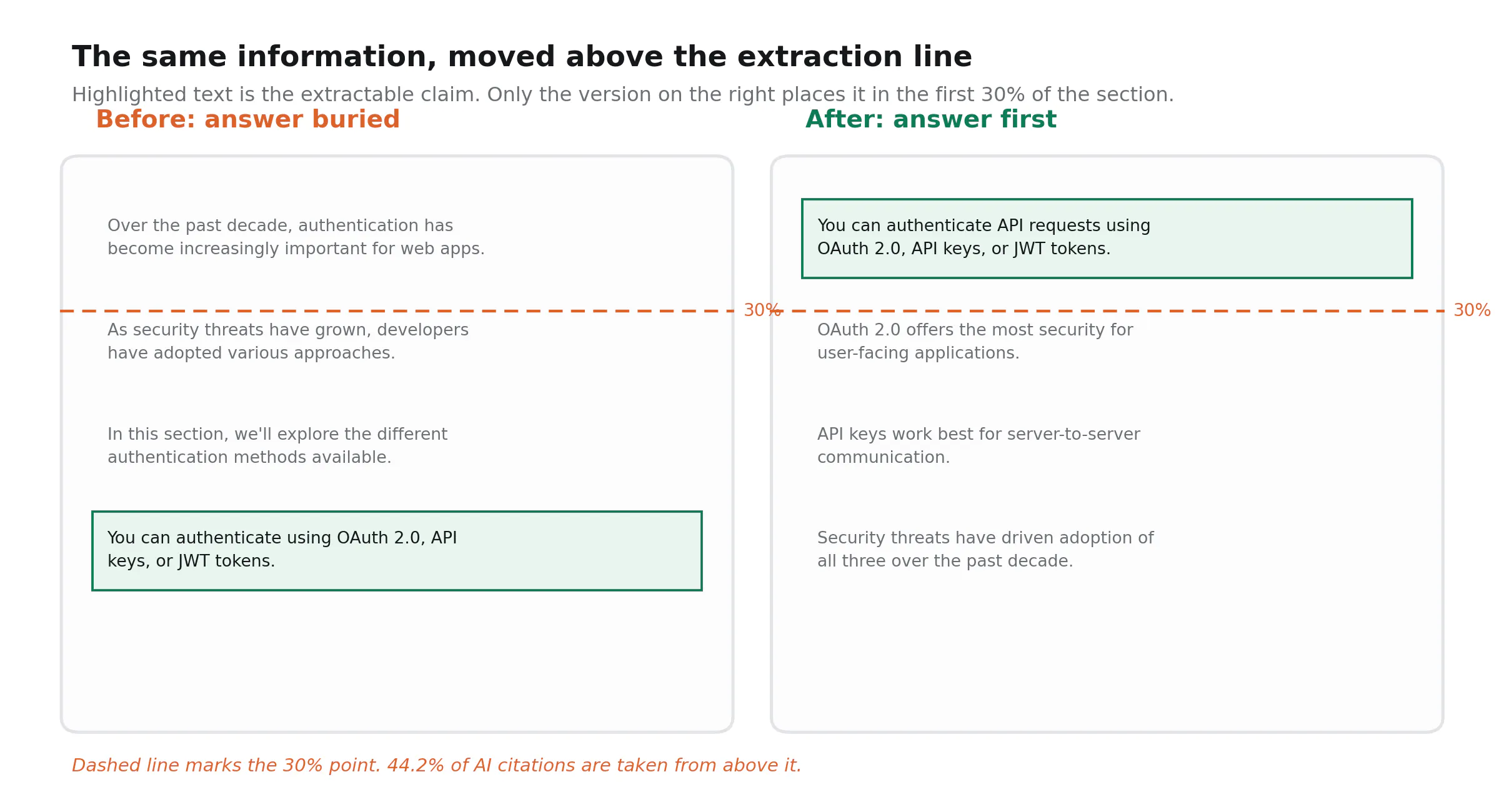
- Move the answer into the first 30% of the page. Given the front-weighting data, this is the single highest-value structural change available. State the answer, then the context, then the evidence.
Before: "Over the past decade, authentication has become increasingly important for web applications. As security threats have grown, developers have adopted various approaches to protect user data. In this section, we'll explore different authentication methods."After: "You can authenticate API requests using OAuth 2.0, API keys, or JWT tokens. OAuth 2.0 offers the most security for user-facing applications, while API keys work best for server-to-server communication."
The second version puts an extractable claim in sentence one. The first version's opening 30% contains nothing an AI could quote.
- Write each heading as the question people actually ask. Growth Memo and AirOps analysed 815,000 query-page pairs across 16,851 ChatGPT queries and 353,799 pages in 10 industries, and found pages whose headlines directly answer the question were cited 41% of the time against 29% for loosely related headlines.
"Understanding User Intent" becomes "What questions are users actually asking?""Authentication Methods" becomes "How do I authenticate API requests?" - Make every section survive being lifted out. Define terms in place. Remove "as we saw above." Kill pronouns that reach backwards to an earlier paragraph. If a section only makes sense in sequence, it cannot be quoted in isolation, and quoting in isolation is the entire mechanism.
- Match the format to the question's intent. Wix and Evertune found informational queries send 45.5% of citations to articles and 21.7% to listicles, while commercial queries flip to 40.86% listicles. Our own experiment found the same shape independently. A long-form guide competing on a "best X" question loses on format before its quality is ever assessed, so the fix is restructuring into a ranked comparison rather than making the guide better.
One caveat from our own report: Google is clamping down on sites publishing large volumes of comparison listicles that over-promote themselves. This is a reason to reshape the pages where a comparison genuinely fits, not a licence to mass-produce them. - Move the facts into visible text. searchVIU built a test page with product prices hidden in different places and asked five AI systems what things cost. Not one found the price that existed only in JSON-LD, even though it appeared nowhere else on the page. ChatGPT and Gemini did find prices marked up in visible Microdata and RDFa, because those sit inside content a person can see.
The rule that follows: if a number matters to a buying decision, it belongs in body text. Metadata is read, but it cannot carry a fact you never published. The same applies to facts stranded in an image, a PDF, or a JavaScript-rendered component. - Add proof a machine can verify. The Princeton-led study presented at KDD 2024 tested nine content changes across 10,000 queries and found that adding statistics, source citations and quotations each raised visibility by 30% to 40%. Keyword stuffing produced a negative result.
For testimonials and social proof specifically: a named customer with a number in visible body text is extractable. A logo strip is not. A quote carousel loaded by JavaScript is not. "Trusted by leading brands" is not, because there is nothing in it to verify.
Step 4: Set a refresh cadence
Changing the date is not a refresh, and nothing in the data suggests it works.
A real refresh means the claims still hold, the numbers are current, the examples are not from a discontinued product, and anything that has been disproved since publication is corrected. Quarterly is enough for most decision-stage pages. Anything citing fast-moving data needs checking more often.
Set the review trigger on the evidence rather than the calendar where you can. If a page's central claim rests on a study, it needs revisiting when a newer study lands, not when three months have elapsed.
Good content hygiene that won't move your AI citations
All of these are worth doing. None of them has evidence of lifting AI citations, and treating them as levers is how teams lose a quarter.
Schema markup. Ahrefs tracked 1,885 pages that added JSON-LD against roughly 4,000 matched controls. AI Mode moved 2.4% and ChatGPT 2.2%, both statistically indistinguishable from zero. Two limits worth knowing: every page in the sample already had 100 or more AI Overview citations, so it says nothing about a page that is not yet visible, and rich results in Google Search remain a perfectly good reason to keep it.
llms.txt. Ahrefs checked 137,000 sites and found 97% of llms.txt files received zero traffic in May 2026. More tellingly, AI bots never went looking for the file on domains that did not have one. Google's Search systems ignore it. There is a genuine use case, which is AI coding assistants pulling product documentation, and that is worth knowing if you sell to developers.
FAQ schema. Google deprecated FAQ rich results in May 2026. FAQ blocks still get extracted well, but that is because they are self-contained answer units, not because of the markup.
Images and custom illustrations. Every ranking guide on this topic recommends adding visuals. Not one cites anything. The nearest evidence is MCiteBench, a 3,000-example ablation, where adding image captions produced only minor changes across most metrics and slightly degraded citation F1 for one model. Alt text is read because it is text sitting in your HTML. The image itself is doing no retrieval work for crawlers that do not render. Add visuals for readers and for image search.
Mistakes to avoid
Writing longer to get cited. Ahrefs analysed 560,346 AI Overviews down to 174,048 pages with extractable content and found a Spearman correlation of 0.04 between word count and citation. 53.4% of cited pages were under 1,000 words; only about 16% were over 2,000.
The honest complication: SE Ranking, across 129,000 domains, found pages over 2,900 words earned 59% more ChatGPT citations than pages under 800. Those two findings are not reconcilable as a single rule, and Ahrefs themselves note the platforms diverge. Our read is that length is a proxy for something else, and the variable that actually moves is whether a section completely answers one question. Write the section to completeness and let the page length land wherever it lands.
Chunking your content into small blocks. Google states plainly that there is no requirement to break content into small pieces and no ideal page length, and that its systems can surface the relevant part of a page covering several topics. The advice that survives is about page scope, not paragraph size: one section answering one question. Reformatting a sprawling guide into shorter paragraphs changes nothing.
Optimizing before fixing the technical layer. The reason step 1 is step 1.
Refreshing the date instead of the content. It is not a refresh and nothing in the data suggests it works.
Building a separate page for every phrasing. Google's guide addresses this directly and its scaled content abuse policy covers the practice.
Chasing numbers nobody can source. A layer of advice in this field is precise-sounding and completely unverifiable. "72.4% of ChatGPT-cited pages use an answer capsule of 20 to 25 words." "HowTo schema improves citation likelihood from 34% to 87%." "Sections of 120 to 180 words earn 70% more citations." None of these has a published methodology, sample size, or date attached anywhere we could find. They are not necessarily wrong. They are unfalsifiable, which is worse, because you cannot tell when they stop being true.
Frequently asked questions
Do this across your whole content library
Restructuring one page is an afternoon. Restructuring two hundred is a platform problem. We will show you how teams reshape a content library for extraction without a developer in the loop, using your own pages on the call.
Keep reading