
There’s a growing demand for headless commerce in the e‑commerce industry because it gives businesses more control over how their content and products are presented, while keeping backend operations flexible. This approach helps create faster, more personalized, and consistent shopping experiences.
The headless CMS you use to power your online store can make or break your customers’ experience. To help you choose the right platform, we’ve prepared a guide that evaluates six headless CMS platforms to understand how they make it easier to launch and manage your ecommerce operation’s capabilities, channels, and content.
TL;DR (key takeaways)
- All six platforms covered—Prismic, Contentful, Strapi, Payload, Optimizely, and Adobe Commerce—can power a headless ecommerce operation, but each is built for a different kind of team and use case.
- Prismic is a good fit for building component-driven storefronts and optimizing for SEO and GEO performance across hundreds of brand-consistent landing pages.
- Contentful works best for large ecommerce brands that need to deliver personalized, consistent content across multiple channels.
- Strapi gives you full control over content infrastructure, with flexible data modeling and the option to self-host on your own servers.
- Payload is built for developer-led teams that want complete ownership of their commerce backend.
- Optimizely suits teams that need content management, A/B testing, and personalization all in one place.
- Adobe Commerce is the go-to for multi-brand, multi-site B2B and B2C operations at scale.
How we chose our list of best headless CMS for ecommerce in 2026
Every headless CMS on this list covers the essential features you’d expect and need, including content modeling, API delivery, and media asset management, and localization. However, we didn't choose them for that.
We chose them because, beyond those baseline capabilities, as each one brings something extra that's directly useful for ecommerce operations. That's what earned them a spot on this list.
Having said that, let's explore our list of 6 best headless CMS platforms for ecommerce in 2026 and what they offer in more detail.
The table below summarizes the learnings from each platform.
Learn more about headless commerce
Explore our guide to headless commerce, which covers the subject in detail and includes implementation steps.
Platform | Best For | Standout Ecommerce Feature |
|---|---|---|
Prismic | Developers building component-driven storefronts and teams scaling AI search and SEO visibility | SEO/GEO landing page builder |
Contentful | Multi-channel personalization for large ecommerce brands | Hyper-personalized shopping experiences |
Strapi | Developers seeking full infrastructure control and self-hosting flexibility | Flexible inventory and catalog management |
Payload | Developer-led teams that want complete ownership of their commerce backend | Built-in auth, cart, order history, and paywall support |
Optimizely | Teams seeking content management, experimentation, and personalization in one system | Web experimentation and AI-powered personalization |
Adobe Commerce | Multi-brand, multi-site B2B and B2C at scale | Composable storefront with AI-powered merchandising |
Best Headless CMS Platforms for Ecommerce
1. Prismic
Best for: building component-driven storefronts and scaling AI search and SEO-based visibility
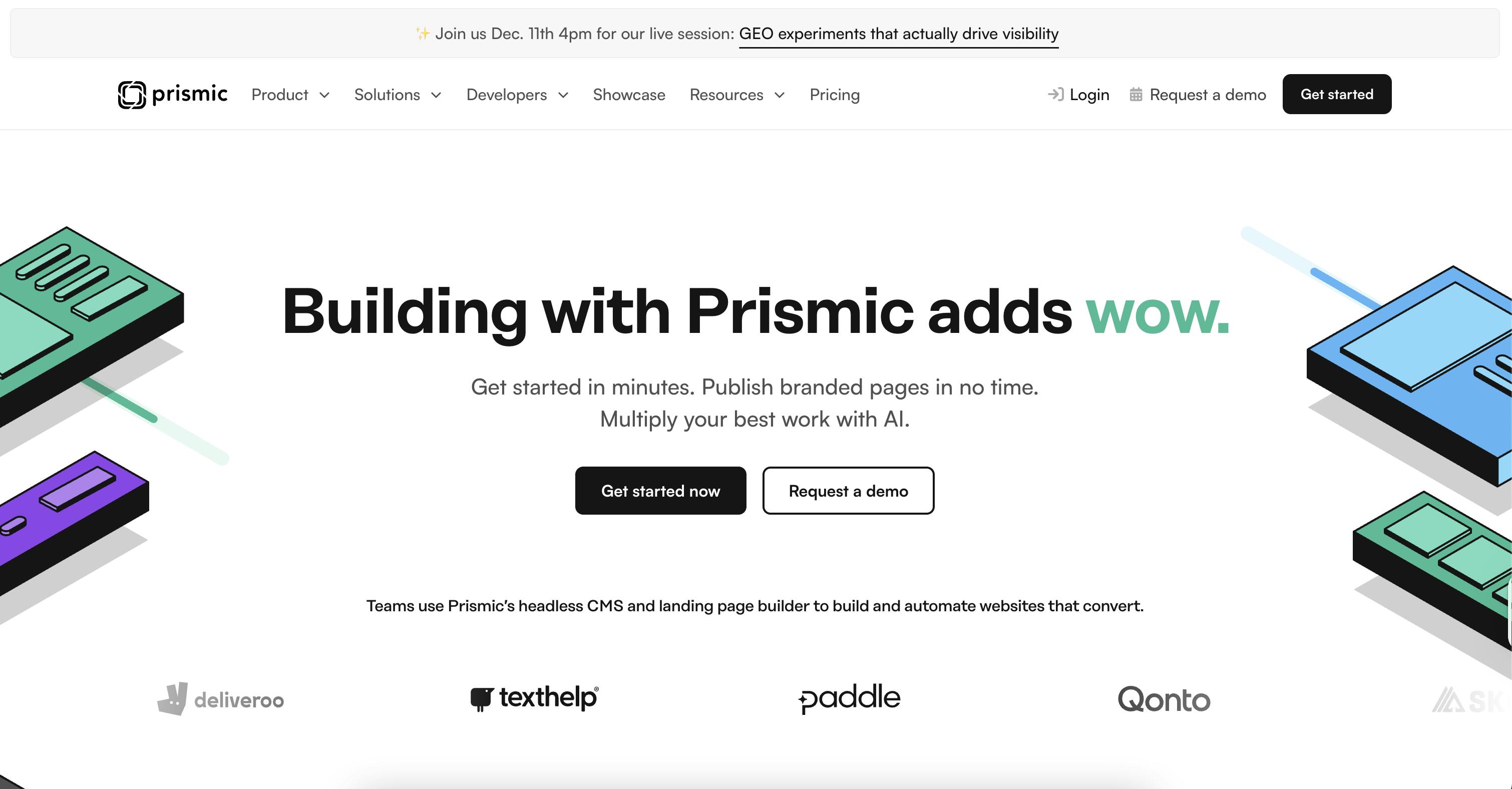
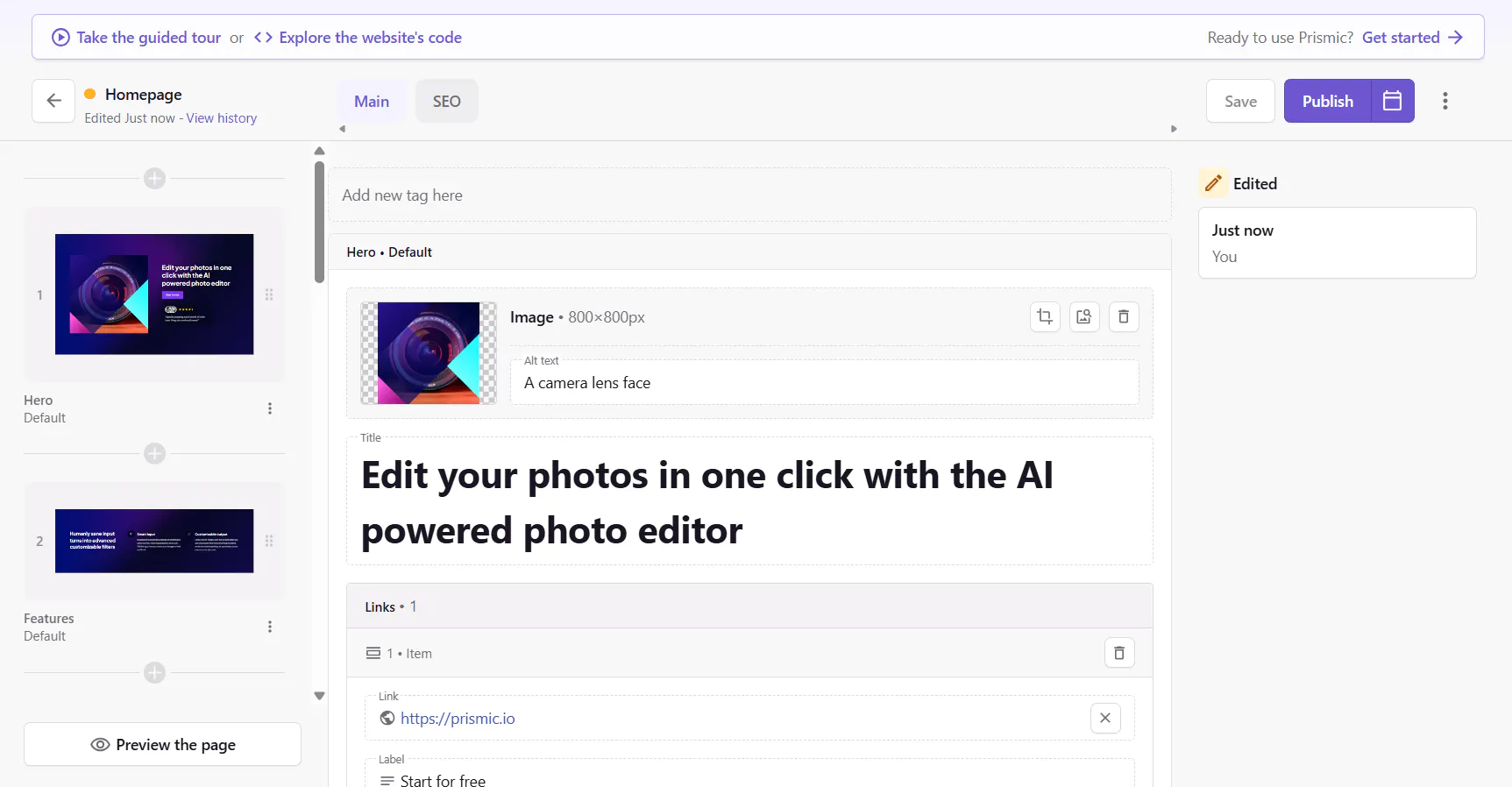
Prismic goes beyond being a headless CMS and is instead a headless website builder that allows developers, via Slice Machine, to build reusable components that marketers can then use via its visual page builder to create and launch pages independently, all without drifting off-brand.
Standout ecommerce features
- ABM landing page builder: Ecommerce brands targeting wholesale buyers, distributors, or enterprise accounts can generate hundreds of personalized landing pages from a single base page without raising a dev ticket or waiting on design. All you need to do is upload your account data in CSV format, and Prismic's AI handles the variations. Every page comes with a traceable URL so you know exactly which accounts are converting.
- SEO/GEO landing page builder: Unlike the ABM builder, which personalizes pages based on who the buyer is, this one is keyword-focused. Upload a CSV of target keywords and Prismic's AI turns them into hundreds of brand-consistent, search-optimized landing pages. Each page is built for both traditional search and AI-generated results, so your product data, pricing, and content appear wherever buyers are searching.
Integrations
Prismic doesn’t provide built-in integrations with third-party platforms, but it allows you to connect external data sources (HubSpot, Google Analytics, Algolia, etc.) through its integration field, either by pulling data from an API, pushing data directly to Prismic, or syncing products from a platform like Shopify.
Limitations
- The slice-based content architecture can take time to fully grasp, especially for teams new to component-driven content modeling.
- Prismic is built specifically for websites, so the platform isn't the right fit if your ecommerce operation needs to deliver content across multiple channels from a single headless CMS.
Pricing
- Free
- Starter ($10/month)
- Small ($25/month)
- Medium ($150/month)
- Platinum ($675/month)
- Enterprise (Custom)
Resources
2. Contentful
Best for: multi-channel personalization for large ecommerce brands
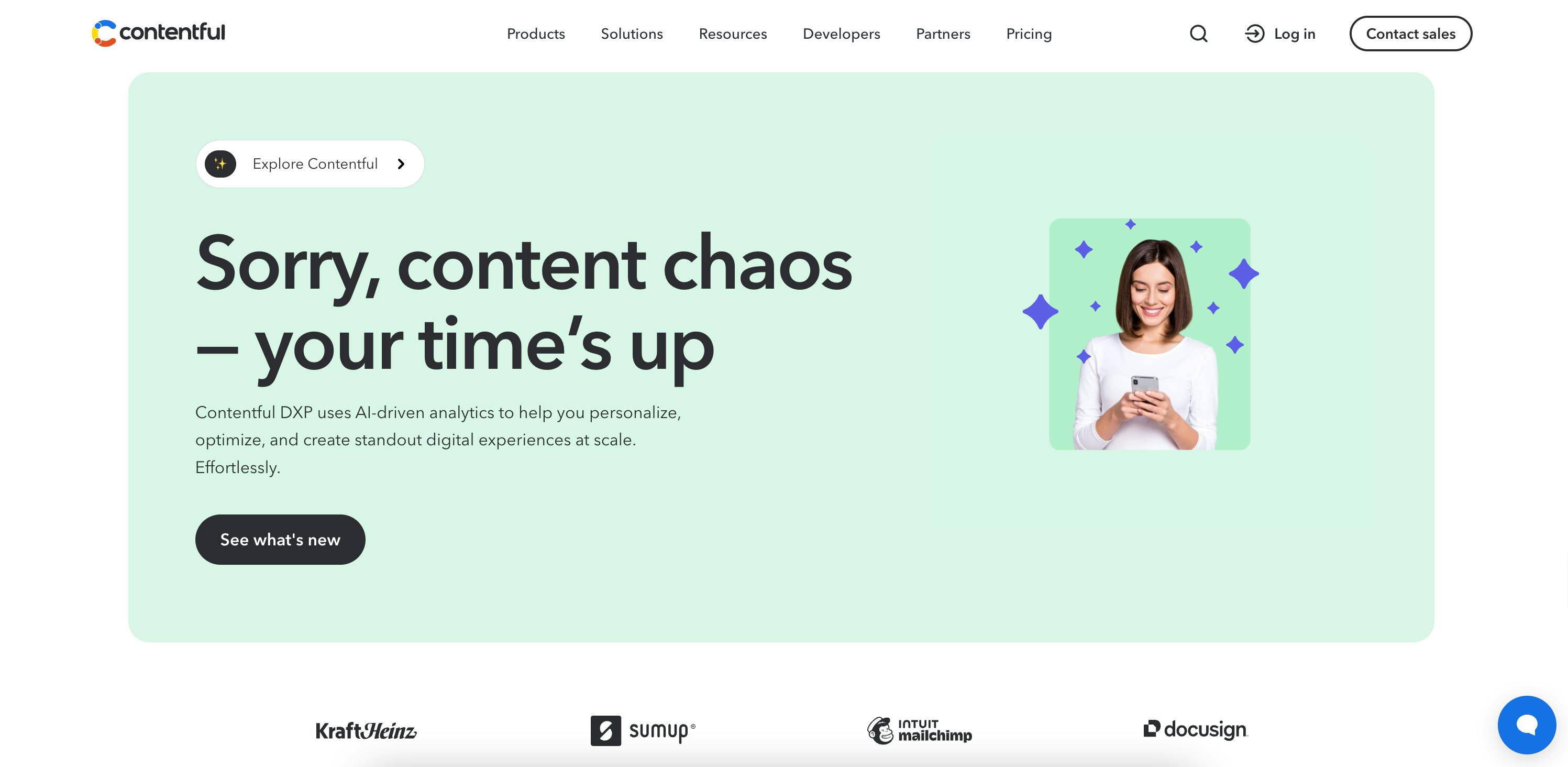
Contentful positions itself as a single platform where teams can create, manage, and reuse modular content components across every channel without the usual copy-paste nightmare. Its strength lies in the combination of composable architecture and built-in personalization and experimentation tools.
Standout ecommerce features
- Hyper-personalized shopping experiences: Contentful pulls together data from your Customer Data Platforms (CDPs), Product Information Management systems (PIMs), and other tools, and uses that to serve each shopper content and product experiences that feel relevant to them.
- A/B testing and experimentation: Marketing teams can run A/B tests and personalization experiments for content, checkout flows, product detail pages, CTAs, and more.
- Customer data connections: It connects with the tools ecommerce teams already rely on, like Shopify and Salesforce CRM. The insights from customers’ data can then be used to improve ecommerce operations.
Integrations
Contentful provides 100+ integrations across its marketplace, including 12 ecommerce-specific apps for platforms like Shopify, Salesforce Commerce Cloud, commercetools, BigCommerce, and SAP Commerce Cloud.
Limitations
- Contentful's paid plans are already steep, as it’s one of the more expensive headless CMS options on the market. On top of that, some features, like personalization, come as paid add-ons, which can further drive costs up for ecommerce teams that need them.
- Contentful caps the number of content models based on your subscription tier. If you hit that limit, the only way to get more is to upgrade your entire plan, even if the content models are the only thing you actually need.
- Contentful has many features, and that depth can work against smaller ecommerce teams. If you don't need enterprise-grade personalization, experimentation, and orchestration, you'll be paying for a platform that does far more than you need.
Pricing
- Free
- Lite ($300/month)
- Premium (custom pricing)
Resources
3. Strapi
Best for: developers seeking full infrastructure control and self-hosting flexibility
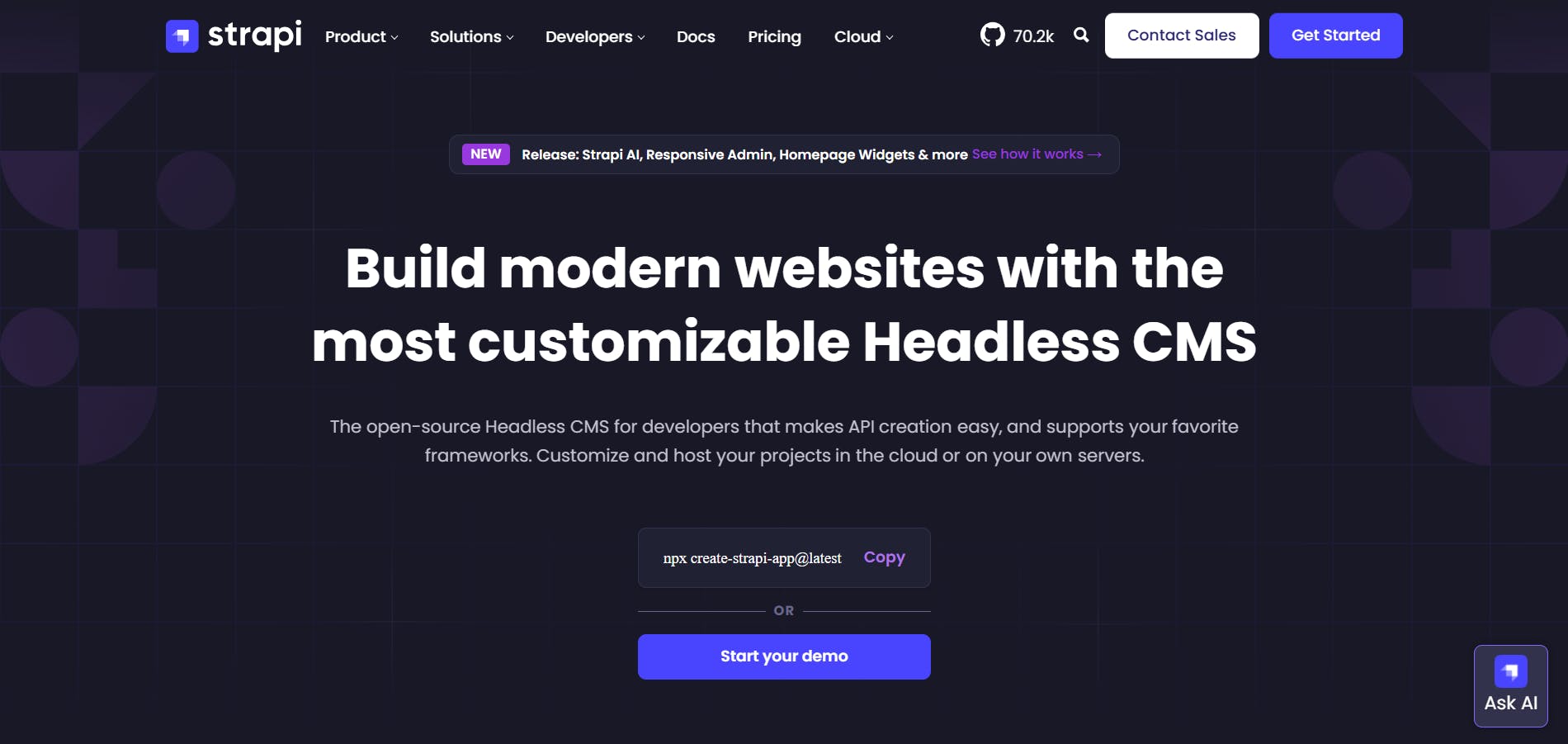
Strapi is an open-source headless CMS that gives developers full control over their content infrastructure. It allows you to design your own data models, generate REST and GraphQL APIs instantly, and deploy on Strapi Cloud or your own servers.
Standout ecommerce features
- Inventory management: Strapi's API-first architecture and flexible content modeling let ecommerce teams manage complex product catalogs and relationships from a single source of truth, without the catalog growing into something unmanageable as the business scales.
- Secure checkout and order management: Strapi handles the backend order logic for your online store, including creating order records, tracking payment status, and processing Stripe webhook events, while keeping sensitive payment data off your servers through Stripe's tokenization.
Integrations
Strapi offers 260 integrations and connects with major ecommerce platforms out of the box, including BigCommerce, Magento, Commerce Layer, and Medusa.
Limitations
- Setting up and managing a headless CMS requires some technical know-how, but Strapi even more so, especially on the self-hosted option. Unlike platforms where you simply register and get directed to a dashboard, getting started with Strapi involves activities like installing Node.js and running scripts before you can even start managing content.
- Choosing the self-hosted option means that you’re responsible for server setup, security patches, scaling, and ongoing maintenance, all of which require resources.
Pricing
- Community (Free)
- Growth ($45/month)
- Enterprise (Custom)
Resources
4. Payload
Best for: developer-led teams that want complete ownership of their commerce backend
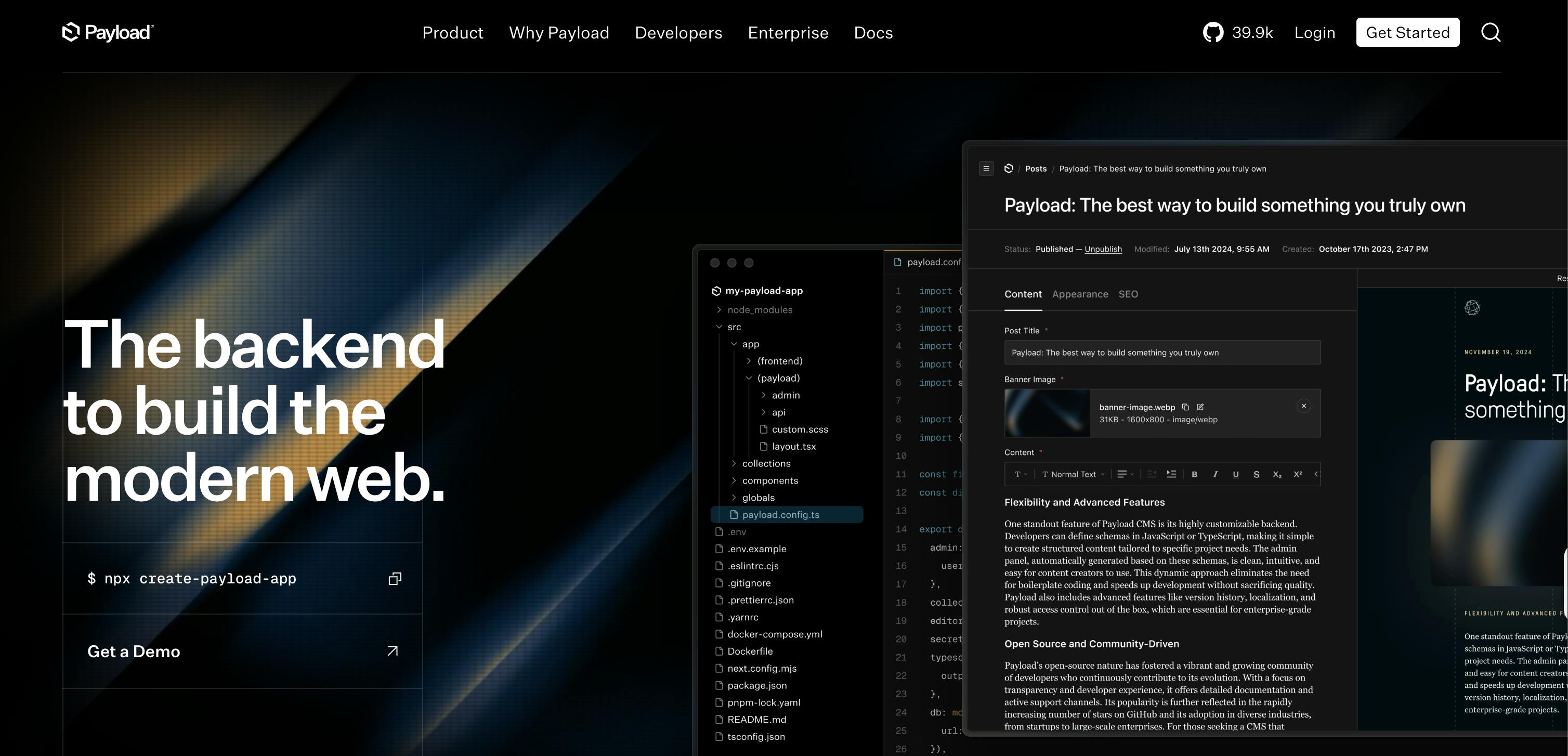
Payload is an open-source, Next.js-native headless CMS that gives developers full control over their backend, content models, APIs, and deployment, while still giving marketers an interface to manage content independently.
Standout ecommerce features
- Stripe integration: Payload connects with Stripe for payments and syncs product details through webhooks. It doesn't handle any currency exchange itself, as all of that runs through Stripe, so sensitive payment logic never touches the CMS.
- Built-in authentication: Customer account management runs through secure, HttpOnly cookies out of the box, so you're not bolting on a third-party auth solution just to manage customer logins.
- Shopping cart and order history: Logged-in customers can have their carts saved to their profiles as they shop, and their purchase history is recorded automatically when they check out.
- Paywall support: You can restrict access to content or digital assets behind a paywall, which is useful for ecommerce stores selling digital products like courses, downloads, or exclusive member content.
Integrations
Payload has a plugin ecosystem that includes an ecommerce plugin that gives you products with variants, cart tracking, orders, transactions, customer addresses, and multi-currency support out of the box. You can also build your own plugins.
Limitations
- Payload requires coding knowledge to use effectively, so non-technical team members like marketers and content editors will regularly need developer support for tasks that other platforms let them handle on their own.
- As a newer platform, Payload's plugin ecosystem is still limited, still growing, and relies heavily on community-built plugins that may not always be actively maintained.
- The dedicated ecommerce plugin is currently in beta, which means breaking changes are possible in future releases.
Pricing
Available on request
Resources
5. Optimizely
Best for: teams seeking content management, experimentation, and personalization in one system
Optimizely is an enterprise digital experience platform that combines content management, experimentation, and personalization into a single system, so marketing teams improve digital experiences without jumping between platforms.
Standout ecommerce features
- Web experimentation: You can run A/B and multivariate tests on product pages, CTAs, and content layouts to find what actually converts.
- Configured Commerce: A low-code B2B commerce solution that covers the full buying journey, including catalog management and AI product recommendations. It also connects with ERP and PIM systems to keep product and customer data consistent across the operation.
- Commerce Connect: Optimizely's customizable commerce solution that combines CMS and commerce in one platform. It supports both B2B and B2C, with personalized experiences, custom checkout flows, and connections to ERP, PIM, and CRM systems.
Integrations
Besides allowing you to create custom integrations, Optimizely provides 100+ connectors, including 20+ ones built for ecommerce operations, such as Shopify, Shopify Plus, Adobe, Salesforce Commerce Cloud, and WooCommerce.
Limitations
The platform's best features live in the newest version, so many existing users have to go through a major migration just to access them. That puts a lot of teams off in the near term, even when the long-term case makes sense.
Pricing
Available on request
Resources
6. Adobe Commerce
Best for: multi-brand, multi-site B2B and B2C at scale
Adobe Commerce is a composable ecommerce platform built for brands operating at serious scale. It handles multi-brand, multi-site, B2B, and B2C from a single platform, so you're not stitching together separate systems for every market or storefront.
Standout ecommerce features
- Digital storefront experiences: You can build and launch personalized storefronts using prebuilt commerce components. Assets are managed through a built-in DAM, and you can run A/B tests without needing developer involvement.
- Personalized commerce experiences: The platform supports customizing every step of the buying journey using AI-powered search and merchandising tools that display the right products to the right shoppers.
- Composable commerce platform: You can build and extend your commerce setup using an API-first architecture with GraphQL and REST APIs, making it straightforward to add new customer touchpoints.
Integrations
Adobe Commerce has an extensive extension marketplace that consists of over 3400 integrations across categories like payment and sales.
Limitations
- The platform may feel bloated for single-store operations, meaning that you’d end up navigating around features you'll never use.
- Installation, customization, and ongoing maintenance all require technical expertise, making it a tough fit for teams without strong dev resources.
- Licensing, hosting, development, and extensions all add up fast, and before long, you're spending significantly more than anticipated.
Pricing
Available on request
Resources
How to Choose a Headless CMS for ecommerce in 2026
The headless CMS you pick will affect various aspects of your ecommerce store, so it's important to choose carefully. Here are some questions to ask each provider before committing to a platform.
- Does the CMS strike the right balance between developer flexibility and a smooth editing experience for non-technical users?
- Does it integrate with your existing commerce engine, and if a native integration does not exist, how straightforward is it to build a custom one?
- Is the content modeling flexible enough to handle product variants, promotions, and campaign assets without rigid structures? Will it still hold up as your catalog grows in size and complexity?
- How does it perform at the API and CDN level, and will it hold up under high traffic? Are there any known performance bottlenecks at scale?
- Does it support locale-specific content variants for multi-region or multilingual storefronts? How much of that localization workflow can your team manage without developer involvement?
- What does pricing actually look like at scale, factoring in users, API calls, bandwidth, and localization fees?
- How much of the content workflow can your marketing team manage without raising developer tickets? Can they launch pages, run campaigns, and make updates independently?
- Does it have strong documentation, an active community, and reliable support to assist you if/when things go wrong?
Recap and next steps
We've covered six headless CMS platforms that go beyond the basics to support real ecommerce operations, providing features like AI-powered landing page generation and multi-channel personalization to composable commerce and enterprise-scale catalog management.
Each platform has its strengths, and the right one for your team comes down to your ecommerce needs. Ready to get started with Prismic? Create a free account.