
Not every headless CMS is built with React developers in mind. Some ship SDKs that feel like an afterthought, others lack TypeScript support beyond basic types, and a surprising number still treat Next.js App Router as an edge case rather than a default. As React moves ever closer to server-side rendering and React Server Components become the norm, the gap between CMS platforms that genuinely support the modern React ecosystem and those that don't has grown considerably.
In this post, we're going to walk through six headless CMS platforms that stand out specifically for React and Next.js projects in 2026. We'll look at each platform's SDK quality, TypeScript support, App Router compatibility, pricing, and more. By the end of this post, you'll have a clear picture of which platform fits your project and what trade-offs you're accepting with each one.
TL;DR
- Prismic is best for Next.js visual page building, with Slice Machine, generated TypeScript types, full App Router support, and live preview out of the box.
- Sanity is the best choice if you want a fully customisable editing experience built in React, with GROQ for precise data fetching and 40+ starter templates.
- Contentful remains the market leader for enterprise React projects, offering both REST and GraphQL APIs with solid Next.js App Router integration.
- Payload CMS 3.0 installs directly inside a Next.js app as a plugin, making it the most tightly integrated option for full-stack Next.js projects.
- Strapi is the go-to for self-hosted, open-source projects, with auto-generated REST and GraphQL APIs and a free community tier.
- DatoCMS is a strong pick for TypeScript-first teams, offering a
@datocms/cda-clientpackage with a GraphQL API and a dedicatedreact-datocmspackage with a responsive image component and real-time updates. - App Router and React Server Component support is now a baseline expectation, with the majority of platforms meeting that.
What makes a Headless CMS "React-ready"?
A Headless CMS earns the label "React-ready" when it covers three key areas.
- It needs a typed SDK, meaning TypeScript types that are generated from your actual content model rather than hand-maintained ones.
- It should offer React-specific utilities like hooks, components, or a context provider that integrate into component-based code.
- It should work with React Server Components, so you can easily fetch and render content on the server.
Learn more about Headless CMS
If you want a broader introduction to the headless CMS category, the Prismic Headless CMS Guides are a resource worth checking out.
Here is a quick overview of the Headless CMS providers we’re going to cover in this post and the key highlights for each one.
Platform | Best For | Next.js App Router | TypeScript Support |
|---|---|---|---|
Prismic | Visual page building with Next.js | Full support | Generated types via Slice Machine |
Sanity | Customisable editing experiences | Full support | Type-safe GROQ with defineQuery |
Contentful | Enterprise projects | Full support | GraphQL codegen available |
Payload CMS | Full-stack Next.js apps | Native (installs inside app) | TypeScript-first, code-defined schema |
Strapi | Self-hosted, open-source | Full support | OpenAPI-based TypeScript generation |
DatoCMS | TypeScript-first projects | Full support | TypeScript-ready @datocms/cda-client |
Top Headless CMS Platforms for React in 2026
Prismic
Best for Next.js visual page building
Prismic is a hosted headless CMS that centers its React integration around Slice Machine, a local development tool for building page section components called Slices. Each Slice is a reusable React component tied to a content model that editors control. The result is a workflow where developers build components locally, push them to Prismic, and editors compose pages from those components without needing to edit any code.
Strengths
- Slice Machine generates TypeScript types from your content model automatically, so your slice component props are always in sync with your schema.
- Slice components can be React Server Components for performance, or Client Components when you need interactivity. The SliceZone component handles both transparently.
- Full Next.js App Router support with examples using async page components, dynamic route segments like app/[uid]/page.tsx, and tag-based cache revalidation via webhooks.
- Draft Mode support for live preview during editing, with preview routes configured via @prismicio/next.
- The @prismicio/next package includes PrismicPreview for automatic page refresh during editing sessions.
- Starter templates are available, including the Next.js minimal TypeScript starter, which ships with Slice Machine, TypeScript, and App Router already configured.
Limitations
- Slice Machine can be harder to grasp conceptually, increasing friction and the time to onboard new users not used to component-driven content workflows.
- The repository-per-project model means each Prismic project is isolated, so it isn't a good fit if you need to deliver content to multiple channels from a single headless CMS.
Pricing
- Free
- Starter ($10/month)
- Small ($25/month)
- Medium ($150/month)
- Platinum ($675/month)
- Enterprise (Custom)
Resources
Sanity
Best for developer-customisable editing experiences
Sanity takes a different approach to the CMS editing experience. Sanity Studio, the content editing interface, is itself a React application; you define your content schema in TypeScript files, and the Studio renders the editing UI from that schema. This means you can install NPM packages, write custom components, and extend the editor with the same tools you use in your own frontend.
Strengths
defineQueryfromnext-sanitygenerates TypeScript types based on both your schema and your GROQ queries, producing asanity.types.tsfile that gives you type safety all the way from your content model to your component props.- Full Next.js App Router support. Sanity's
preview-kitincludes live preview support for React Server Components with the App Router. - Real-time collaboration is built in, with keystroke-level synchronization and one-click content restore.
- Sanity Exchange offers 40+ React templates, plugins, and guides, including starters for Next.js, Gatsby, and other frameworks.
- The GROQ query builder GROQD wraps Zod validation, letting you validate API responses alongside generating TypeScript types.
Limitations
- GROQ is a proprietary query language. There's a learning curve if your team is coming from REST or GraphQL backgrounds.
- Sanity Studio's full customisability is also its complexity. Teams that want an out-of-the-box editor without configuration may find the setup overhead significant.
Pricing
- Free
- Growth ($15/seat/month)
- Enterprise (Custom)
Resources
Contentful
Best for enterprise React projects
Contentful is the longest-standing major player in the headless CMS market, and its ecosystem reflects that. It offers both a REST Content Delivery API and a GraphQL API, a broad set of third-party integrations, and extensive documentation for JavaScript and TypeScript projects. For enterprise teams that need a proven platform with strong support, Contentful is a reliable choice.
Strengths
- Both REST and GraphQL APIs are available. Teams that want to use
@graphql-codegen/cliwith Contentful's GraphQL schema can generate TypeScript types automatically, giving them type-safe content queries. - Next.js App Router is supported. Contentful's own documentation covers creating listing and detail pages with React Server Components, including data revalidation when content is published.
- Contentful Live Preview works with both standard implementations and React Server Component-only implementations, though GraphQL is the recommended approach when using live preview.
- A broad ecosystem of community starter templates and example applications is available on GitHub.
- The Experiences SDK provides React support for building dynamic component-driven experiences.
Limitations
- TypeScript types are not generated from the content model by default. You need to configure them separately, which adds configuration overhead compared to platforms like Prismic or Sanity.
- The jump from the free tier to the Lite plan at $300 per month is steep for small teams or independent developers.
- The admin interface prioritises the editorial experience over the developer experience. Developers working on content model changes will find it less code-first than Payload or Sanity.
Pricing
- Free
- Lite ($300/month)
- Premium (Custom)
Resources
Payload CMS
Best for Next.js-native, full-stack projects
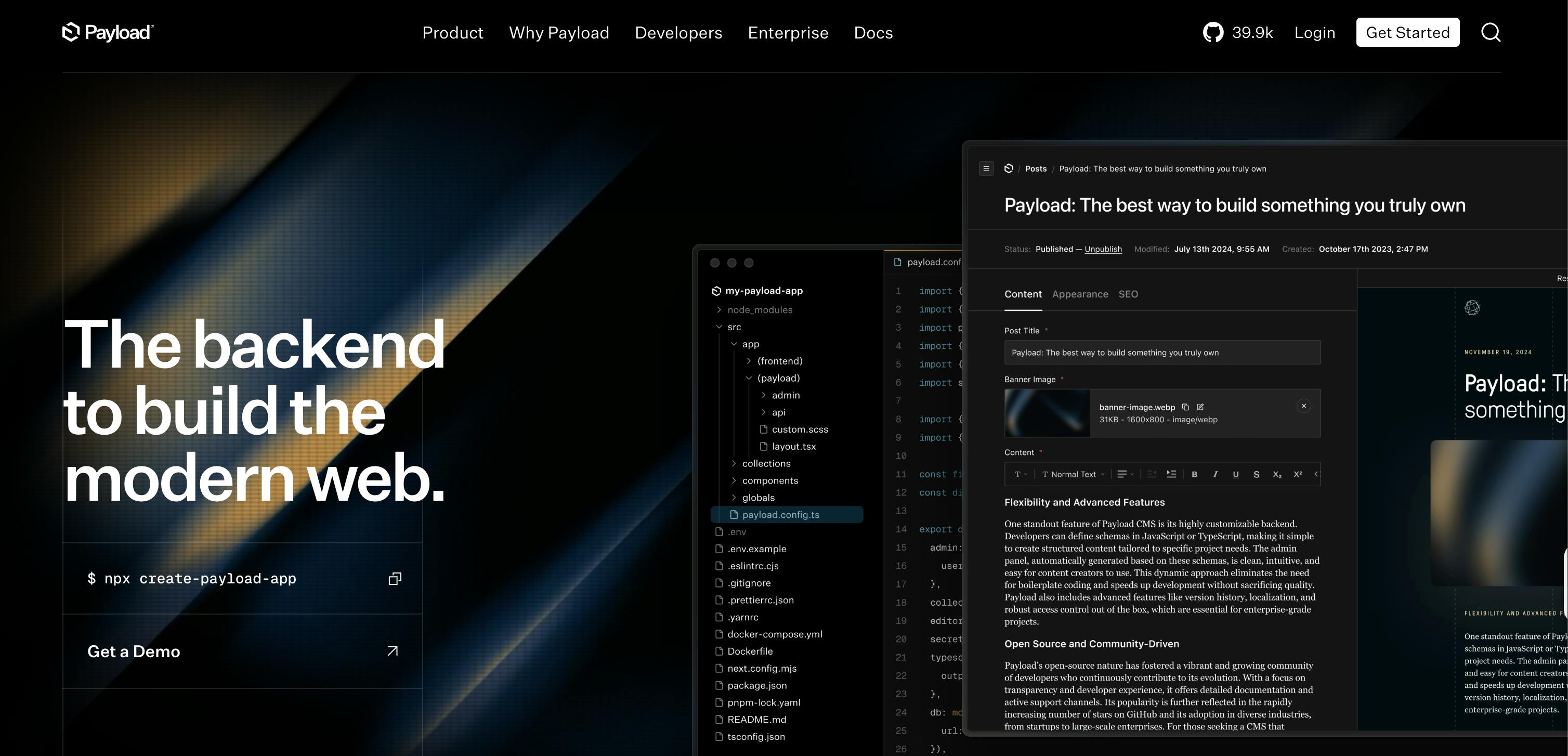
Payload CMS 3.0 takes a fundamentally different architectural position from every other CMS in this list. Rather than running as a separate service you call via API, Payload installs directly inside your Next.js app folder as a plugin. Your CMS admin panel, your API routes, and your frontend all live in the same repository and are deployed together. This architecture Payload describes as being the first CMS to install directly into any Next.js app.
Strengths
- Payload 3.0 completely replatformed its admin panel from a React Router single-page application onto the Next.js App Router with full React Server Component support.
- The Payload Local API lets you query your database directly from React Server Components like a type-safe ORM, bypassing the HTTP layer entirely when you're fetching data in server components.
- TypeScript is not an option, but the foundation. The entire configuration, schema, and query layer is written in TypeScript.
- One-click deployment is available via Vercel and Cloudflare, allowing fully serverless deployments.
Limitations
- Payload is self-hosted by default, which could be off-putting to some teams. If you want managed hosting, you’re currently unable to with Payload as new sign-ups to Payload Cloud were paused following Payload joining Figma.
- The code-first schema approach is a strength for developers but may be a friction point in teams where non-technical editors need to manage the content model.
- Because Payload runs inside your app, it's a full-stack commitment. It's not well-suited to projects that want to reuse the CMS across multiple channels.
Pricing
- Free (Self-hosted)
Resources
Deliver a fast website with a visual Page Builder
Prismic is a headless solution, with a visual Page Builder for your marketing team to release pages independently.

Strapi
Best for self-hosted, open-source projects
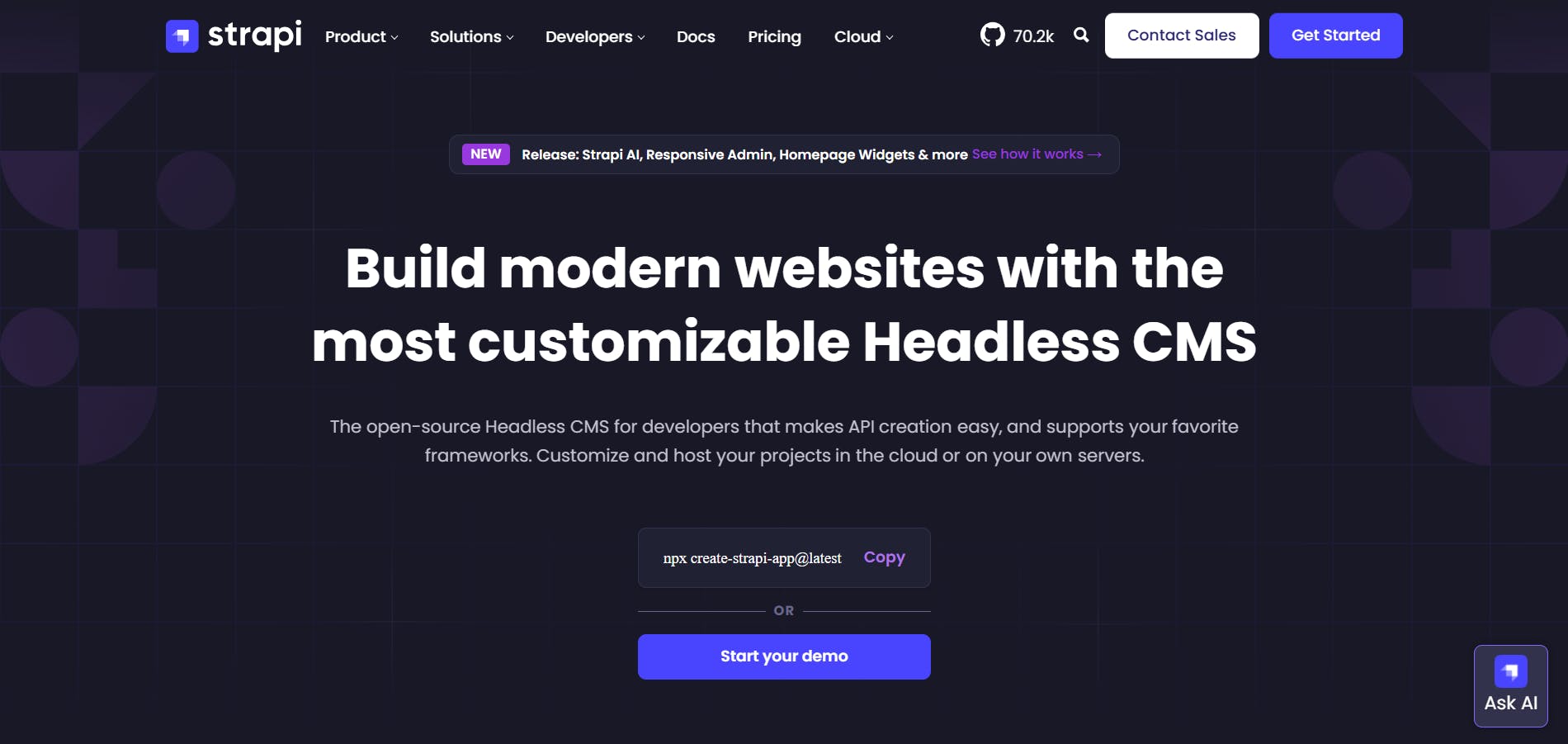
Strapi is the most widely adopted open-source headless CMS, with the project accumulating over 70k GitHub stars. It takes a code-first approach to content modeling, where you define collections and single types in configuration files, and Strapi automatically generates both REST and GraphQL APIs from those definitions. This automatic API generation is one of its strongest practical advantages: you model your content, and the API is ready without additional setup.
Strengths
- Strapi automatically generates both REST and GraphQL APIs from your content model, giving React and Next.js developers a choice of query style without additional configuration.
- Next.js App Router and React Server Components are fully supported.
- Strapi is database-agnostic, supporting SQLite, PostgreSQL, and MySQL, which gives teams control over their data infrastructure.
- The plugin system lets you extend Strapi's functionality through NPM packages, including custom field types, middleware, and authentication providers.
Limitations
- Self-hosting requires you to manage your own server, database, and deployment pipeline. Strapi Cloud provides managed hosting, but adds cost.
- Strapi's CMS and cloud hosting plans are now priced separately, which can make the total cost less obvious when planning a project budget.
Pricing
CMS Pricing
- Free
- Growth ($45/month)
- Enterprise (Custom)
Cloud Pricing
- Free
- Essential ($18/month)
- Pro ($90/month)
- Scale ($450/month)
Resources
DatoCMS
Best for TypeScript-first React projects
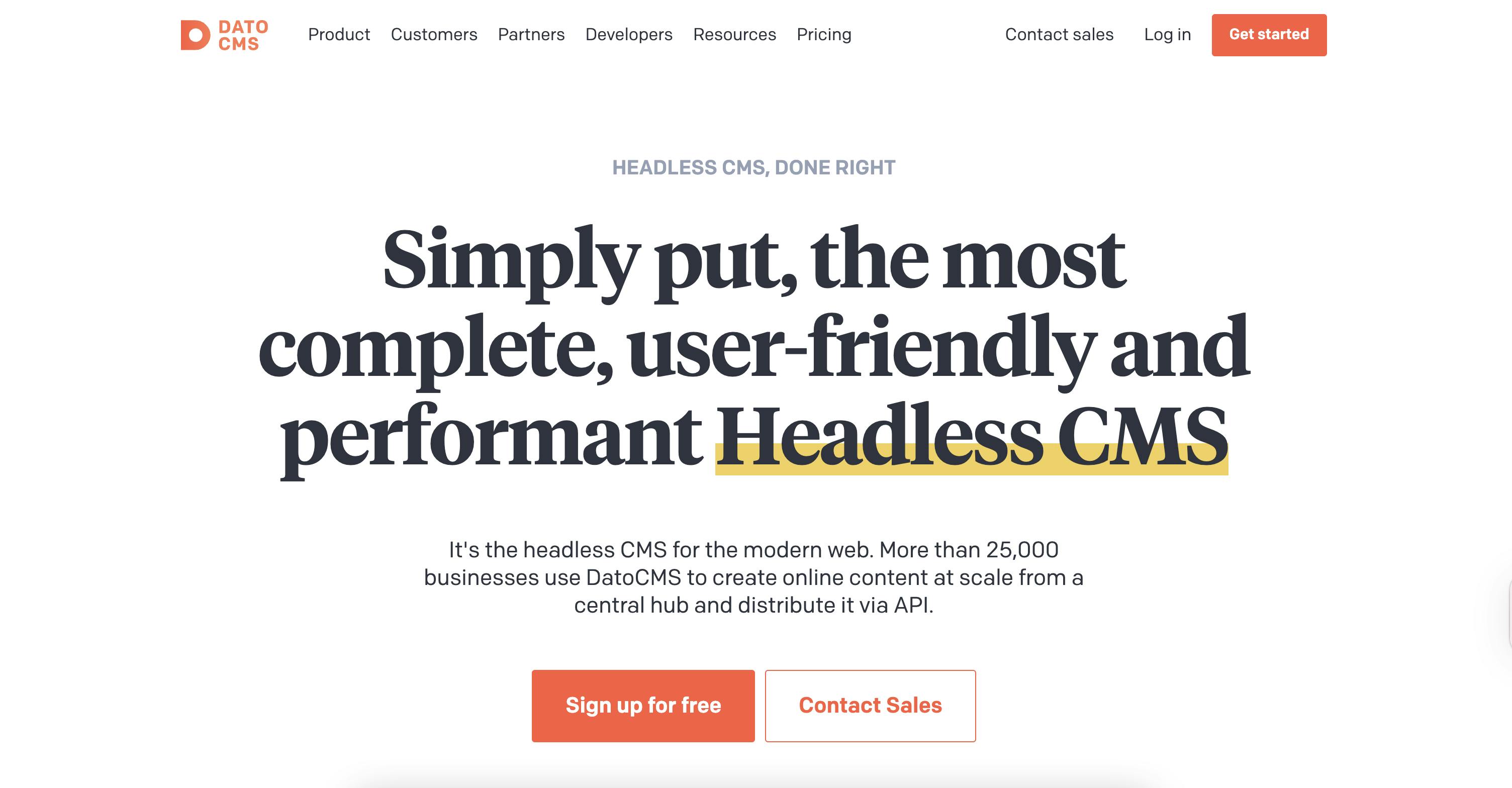
DatoCMS is a hosted headless CMS with a GraphQL-only Content Delivery API, making it the most opinionated choice in this list from a query API perspective. That constraint pays off for TypeScript teams as GraphQL's typed schema pairs naturally with codegen tools, and DatoCMS leans into this with the @datocms/cda-client package, which is described as a lightweight, TypeScript-ready package built on the native Fetch API.
Strengths
- The Next.js App Router is the primary integration path. DatoCMS's own Next.js documentation focuses exclusively on App Router, recommending server-side data fetching to reduce client-server round-trips, aligning with React Server Component patterns.
- DatoCMS supports live content updates through
react-datocms, enabling real-time preview of content changes in the browser. - Official Next.js starter templates are available on GitHub.
Limitations
- DatoCMS uses only GraphQL for its Content Delivery API. Teams that prefer REST or want to avoid the GraphQL setup overhead will need to look elsewhere.
- The free plan is limited to 300 records and 10 GB of traffic per month, with no overages allowed. It's fine for prototyping but might constrain larger production projects.
Pricing
- Free
- Professional ($149/month)
- Enterprise (Custom)
Resources
React Server Components & Headless CMS: What Changed for 2026
React Server Components (RSC) shifted the default rendering model for Next.js applications. Before RSC, the typical pattern was to fetch CMS content at the page level using getStaticProps or getServerSideProps, then pass that data down through props to the UI. The App Router replaced this with async Server Components, where data fetching lives inside the component itself and runs exclusively on the server.
This change has meaningful implications for how headless CMS SDKs function. Previously, an SDK that required a React Context provider wrapping the app, or one that relied on browser-only APIs for authentication, had to be redesigned to work inside a Server Component. The majority of headless CMS platforms, including the ones we've covered in this post, have had to go through this redesign over the last few years.
All 6 of the platforms covered in this post support RSCs natively, which is also a wider reflection of the overall state of RSC support in the headless CMS industry. The differentiator between them is now how seamless their integration feels to the user and whether live preview, which has traditionally been the hardest feature to move server-side, works smoothly with RSCs.
What should you look for in a React CMS SDK?
Now that we've reviewed the various headless CMS platforms in this post, here is a checklist you can use for evaluating any headless CMS SDK for your future React/Next.js projects.
Generated TypeScript types. The best CMS SDKs generate TypeScript types directly from your content model. This means that when you add a new field in the CMS, your component types update automatically. Platforms like Prismic and Sanity do this by default. Others require you to set up codegen manually. Either approach works, but the degree of automation matters for ongoing maintenance and the wider developer experience.
React Server Component compatibility. Check whether the SDK's client can be imported and used inside an async Server Component without errors. SDKs that depend on browser APIs like window, localStorage, or React Context wrapping the app will fail in an RSC environment. Most modern SDKs have addressed this, but it's worth verifying with the platform's current documentation before committing to it.
Next.js App Router documentation. If the platform's Next.js documentation still defaults to Pages Router examples or treats App Router as an advanced topic, that's a signal that their integration may lag behind others. Next.js App Router has been stable since Next.js 13.4 and is now the default. A well-maintained CMS integration should treat it as the default as well.
Data fetching flexibility. Consider whether you need REST, GraphQL, or both. Some teams strongly prefer the predictability of GraphQL while others prefer the simplicity of REST. Platforms like Contentful and Strapi give you both. Sanity uses GROQ, which is more expressive than either but requires learning a new query language. DatoCMS offers only GraphQL. Know what your team requires and check the tool supports it before committing.
Starter templates. A maintained Next.js starter template with TypeScript, App Router, and your chosen CMS is valuable, not just for getting started quickly but as a reference implementation. It shows you the conventions the platform recommends and reduces the risk of setting up the integration incorrectly from the beginning.
Recap
In this post, we've covered six headless CMS platforms within the context of React and Next.js in 2026: Prismic, Sanity, Contentful, Payload CMS, Strapi, and DatoCMS.
And, as we've seen, each of them has a distinct position: Prismic for visual page building, Sanity for editorial customisability, Contentful for enterprise scale, Payload for full-stack Next.js integration, Strapi for self-hosted open-source projects, and DatoCMS for TypeScript-first teams with a GraphQL API preference.
We also looked at how React Server Components have changed what is required for a headless CMS platform to be considered viable in 2026 and what you should evaluate when choosing a CMS SDK for your next projects.
Thank you for reading.