Top 7 Headless CMS Platforms for Startups in 2026 (Full Comparison)
 By Coner Murphy
You've got a product to ship, a small team, and content that needs to be published yesterday. So you open your browser, search "best headless CMS," and immediately face a wall of options: Sanity, Contentful, Strapi, Storyblok, Prismic, Hygraph, DatoCMS, and a dozen more. They all promise flexibility, great developer experience, and the ability to scale. But the pricing pages tell a different story. Some platforms look free until you hit a hard limit at the worst possible time. Others start affordable but jump to hundreds of dollars a month the moment they start expanding.
Choosing the wrong CMS earlier on isn't just inconvenient. It's a painful migration right when your product is gaining traction, your marketing team is scaling blog output, and your engineers have zero spare time. That's the kind of technical debt that costs you days, not hours.
So, in this post, we're going to look at the top headless CMS platforms for startups in 2026, compare them on the things that actually matter, and help you pick the right one for your situation.
TL;DR (key takeaways)
- Prismic: Best for early-stage SaaS marketing sites. Fast setup, visual editor, free to get started, no DevOps required.
- Sanity: Best for developer teams that want full flexibility. Generous free tier with 20 seats, schema-as-code in TypeScript, great for AI-driven content workflows.
- Strapi: Best for MVPs on a tight budget. Open-source and free to self-host, but you own the infrastructure.
- Storyblok: Best when your marketing team needs to move without waiting on engineers. Drag-and-drop editor and free starter tier.
- Contentful: Best for startups planning rapid internationalization. Mature platform, huge ecosystem, but pricing steps up sharply at the Lite tier ($300/month).
- Hygraph: Best for teams building tightly integrated, scalable apps. GraphQL-native with a free Hobby tier.
- DatoCMS: Best for speed of setup and media-heavy content. GraphQL-first, built-in image CDN, free tier available, Professional plan from €149/month billed annually.
What Startups Should Prioritize in a Headless CMS
Before comparing platforms, it's worth defining what "good for startups" actually means. Because ultimately, the criteria that matter for an enterprise with a dedicated DevOps team are not the same criteria that matter for a four-person earlier-stage company.
One of the most important metrics to consider is time-to-first-content. How quickly can you go from signing up to having real content in front of real users? Some platforms require significant setup, custom Studio configuration, or infrastructure provisioning before you can publish anything. That setup cost is real, and it matters when you're trying to move quickly as a startup.
The second thing is the free tier. A genuinely useful free tier lets you validate your content architecture before spending money. But not all free tiers are equal. A free plan with 300 records and 1 collaborator is barely a proof-of-concept environment. A free plan with 10,000 records and 10 user seats is something you can actually run an early-stage product on.
Third is pricing predictability. This is the one that catches startups off guard most often. A CMS that's $0 today but $300 next month when you add your third locale or your fourth content type creates cash flow stress you don't need. Look at the exact triggers that push you to the next tier, and work out whether your product will hit them before you have the revenue to absorb the jump.
Fourth is developer experience. A CMS that your engineers find difficult to work with will slow down every future content integration, every frontend rebuild, and every data migration. Good DX means clear documentation, predictable APIs, and a schema model that maps naturally to how you think about your content.
Fifth is vendor lock-in. This one is easy to ignore at first and painful to deal with later. Can you export all your content in a standard format? Does the platform use a proprietary query language or standard REST and GraphQL? Our headless CMS guide captures this well: a headless CMS is backend-only, delivering content via APIs to any frontend. The more those APIs follow open standards, the more freedom you retain to switch tools if needed.
Quick Comparison Table
Platform | Best For | Free Tier | Starting Paid Price | Self-Hostable |
|---|---|---|---|---|
Prismic | Early-stage SaaS marketing sites | Yes (1 user, 2 locales) | $10/mo | No |
Sanity | Developer teams, AI-ready content | Yes (20 seats, 10K docs) | $15/seat/mo | Partial (Studio only) |
Strapi | MVPs, full ownership, low cost | Yes (Community edition) | Free (self-hosted) | Yes |
Storyblok | Marketing-led content iteration | Yes (1 user, 20K stories) | $99/mo | No |
Contentful | Internationalization, large ecosystems | Yes (10 users, 10K records) | $300/mo | No |
Hygraph | Tightly integrated, scalable apps | Yes (3 seats, 1K entries) | $299/mo | No |
DatoCMS | Speed, media-heavy content | Yes (1 user, 300 records) | €149/mo | No |
Top Headless CMS Platforms for Startups in 2026
1. Prismic
Best for: early-stage SaaS startups building marketing sites with a strong brand identity
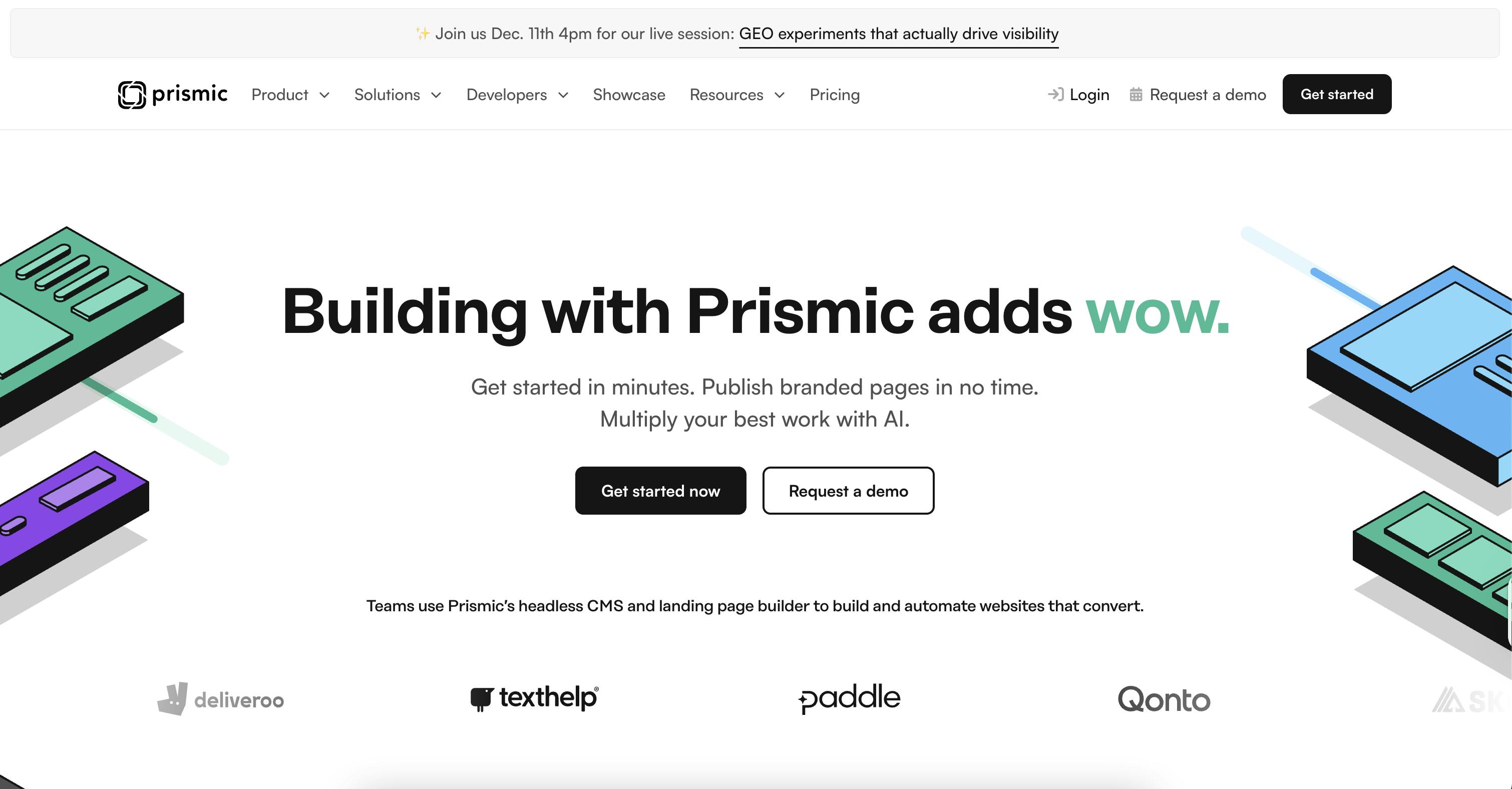
Prismic is built around a concept called Slices: reusable, prebuilt content components that let non-developers assemble rich pages without writing code. Pair that with a visual editor and live preview, and you have a CMS where a founder or marketer can actually manage content without filing a ticket with engineering every time they want to update a landing page.
The free tier includes 1 user and 2 locales, with 4 million API calls and 100 GB of CDN bandwidth per month. That's a generous API allowance for a startup still finding product-market fit. Every tier, including free, includes unlimited documents, slices, types, and assets, along with the visual page builder, image optimization, webhooks, and GraphQL access.
From a startup lifecycle perspective, Prismic suits the MVP and early Growth stages well. You can get your first piece of content live in under an hour, and the non-technical editor experience means your marketing team can iterate on copy and layout without developer involvement.
The main limitation for startups is scope. Prismic is excellent at marketing site use cases, but it's not the right tool if you're building a complex multi-channel content architecture where content needs to be reused across mobile apps, email, dashboards, and web simultaneously.
Startup Lifecycle
Strong at MVP and early Growth. Less suited for Scale-stage multi-channel requirements.
Pricing
Paid plans start at $10/month
You can find getting-started guides in Prismic's documentation.
2. Sanity
Best for: future-focused teams that want maximum flexibility and AI readiness.
Sanity takes a different approach to content modeling than most CMS platforms. Instead of a GUI-based schema builder, you define your content types directly in TypeScript code. That means your content schema lives in your version control system alongside your application code, which makes it reviewable, testable, and deployable the same way everything else is.
The Studio, Sanity's editing interface, is a fully customizable React application. Out of the box, it's capable, but if you need custom input components, bespoke workflows, or deeply integrated previews, you have the code access to build them. Sanity also supports real-time collaborative editing, which is genuinely useful when a content team and editorial team are working on the same document simultaneously.
The free tier is unusually generous: 20 user seats, 2 public datasets, 10,000 documents, 1 million CDN API requests per month, 250,000 API requests per month, and 100 GB of asset storage. For many seed-stage startups, this is a production-viable plan with zero cost. Sanity also runs a Startup Program that offers one year of free access to the Growth plan for early-stage companies. If you qualify, it is worth applying before committing to any paid tier.
The limitation for some startup teams is the learning curve. Non-technical content editors will find Sanity's Studio perfectly usable once it's set up, but the initial configuration requires a developer who's comfortable with TypeScript. If your CMS setup work falls entirely to a solo engineer who's already stretched thin, the schema-as-code approach adds upfront effort that platforms with GUI schema builders avoid.
Startup Lifecycle
MVP (with developer bandwidth), strong at Growth, excellent at Scale with the right technical team.
Pricing
Paid plans start at $15/seat/month
The Sanity documentation has thorough guides for getting started with the Studio and content modeling.
3. Strapi
Best for: MVPs and early products needing full control and low cost.
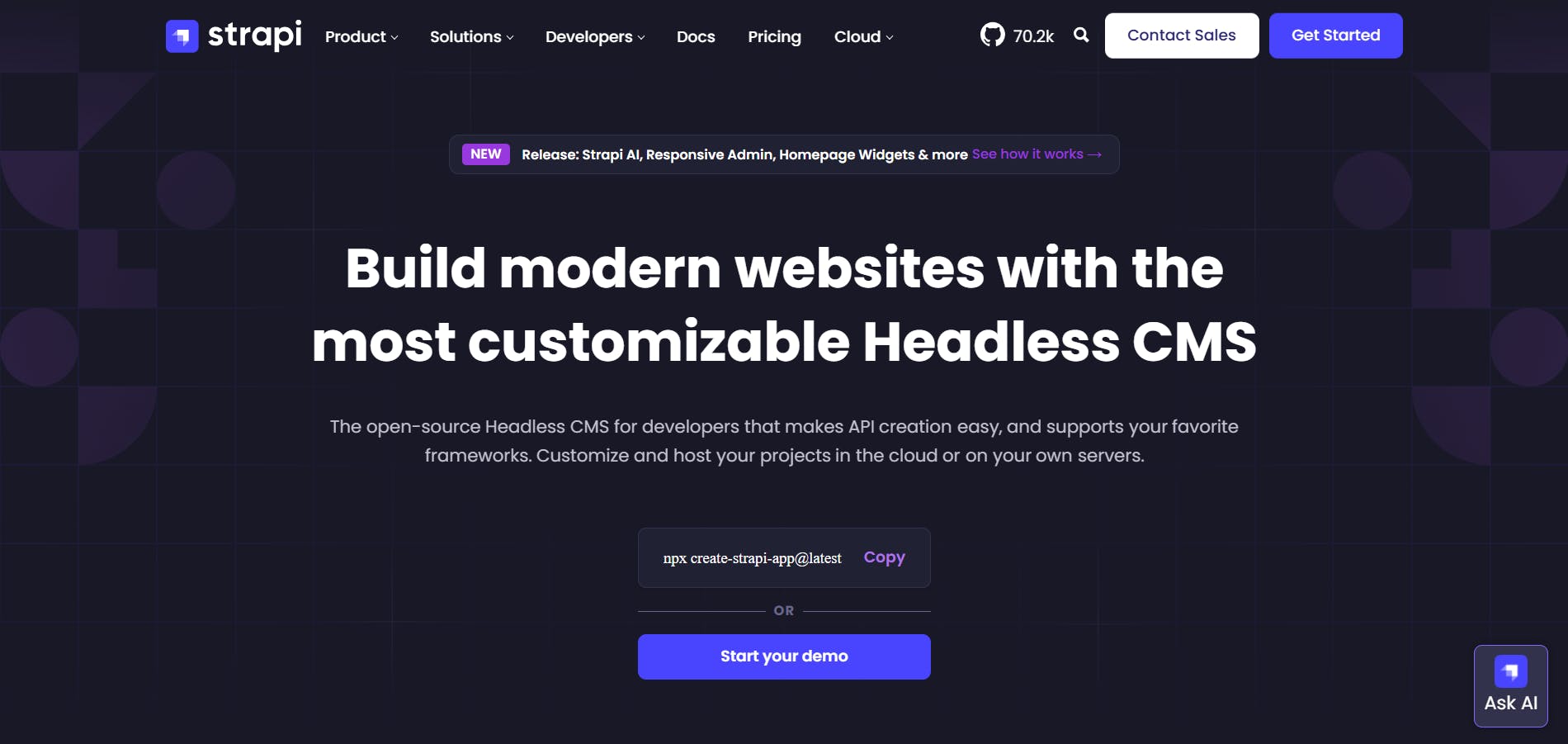
Strapi is open-source and self-hosted, which means the Community edition costs nothing except the infrastructure you run it on. You get a full-featured headless CMS with REST and GraphQL APIs, a customizable admin panel, role-based access control (on paid plans), and the ability to extend behavior through plugins or custom code. The entire codebase is available on GitHub under an MIT license, so there's no black box you're locked out of.
For startups building on tight budgets, this is a compelling proposition. You can run Strapi on a $5/month VPS, a managed container service, or a free-tier cloud instance if your usage is low. Your content data lives wherever you choose to run it, which means full data sovereignty and no exposure to a SaaS vendor's pricing decisions.
Strapi also offers managed hosting via their Cloud product if you want to avoid the infrastructure work, but it starts at $45 per seat per month.
This poses a real trade-off. Self-hosting means you own the DevOps burden: upgrades, security patches, backups, performance tuning, and uptime monitoring are all your responsibility, and for a startup with an engineer who's comfortable with that, it's likely not an issue. But for a small team where every hour of engineering time is precious, it's worth factoring in the ongoing maintenance cost into the total cost of ownership.
Strapi's community is one of the largest in the headless CMS space, which means common questions' answers, community plugins, and third-party tutorials are abundant, which is valuable when you're troubleshooting at 11 PM before a product launch.
Startup Lifecycle
Excellent for MVP (lowest cost, full control). Good for Growth. Scale requires careful capacity planning.
Pricing
Hosted options start at $45/seat/month.
The Strapi documentation covers self-hosted setup and Cloud deployment in detail.
4. Storyblok
Best for: startups where the marketing team must move independently from engineering.
Storyblok is built around a visual, drag-and-drop editing interface. Content editors see a live preview of the page as they make changes, with a component panel on the side. For a startup where the marketing team is running content independently while engineering is focused on the product, this matters. Editors don't need to understand content modeling or ask a developer to create a new page layout.
Under the hood, Storyblok uses a component-based structure. Content blocks are reusable components that keep things organized even when non-developers build pages. The API is REST and GraphQL, so frontend developers have standard options for content fetching.
However, the limitation you need to watch for is the flexibility of complex data relationships. Storyblok is excellent when the content maps well to pages and components. But when you need deeply relational data models where a piece of content references and is referenced by many other content types, the visual-first approach becomes a constraint. The API also has reduced flexibility for bulk operations compared to more developer-centric platforms.
Startup Lifecycle
Strong at MVP and Growth for content-driven and marketing-heavy products. Growth Plus and Enterprise for Scale.
Pricing
Paid plans start at $99/month
You can find framework-specific getting-started guides in the Storyblok documentation.
Deliver a fast website with a visual Page Builder
Prismic is a headless solution, with a visual Page Builder for your marketing team to release pages independently.

5. Contentful
Best for: startups expecting rapid internationalization or needing a deep integration ecosystem.
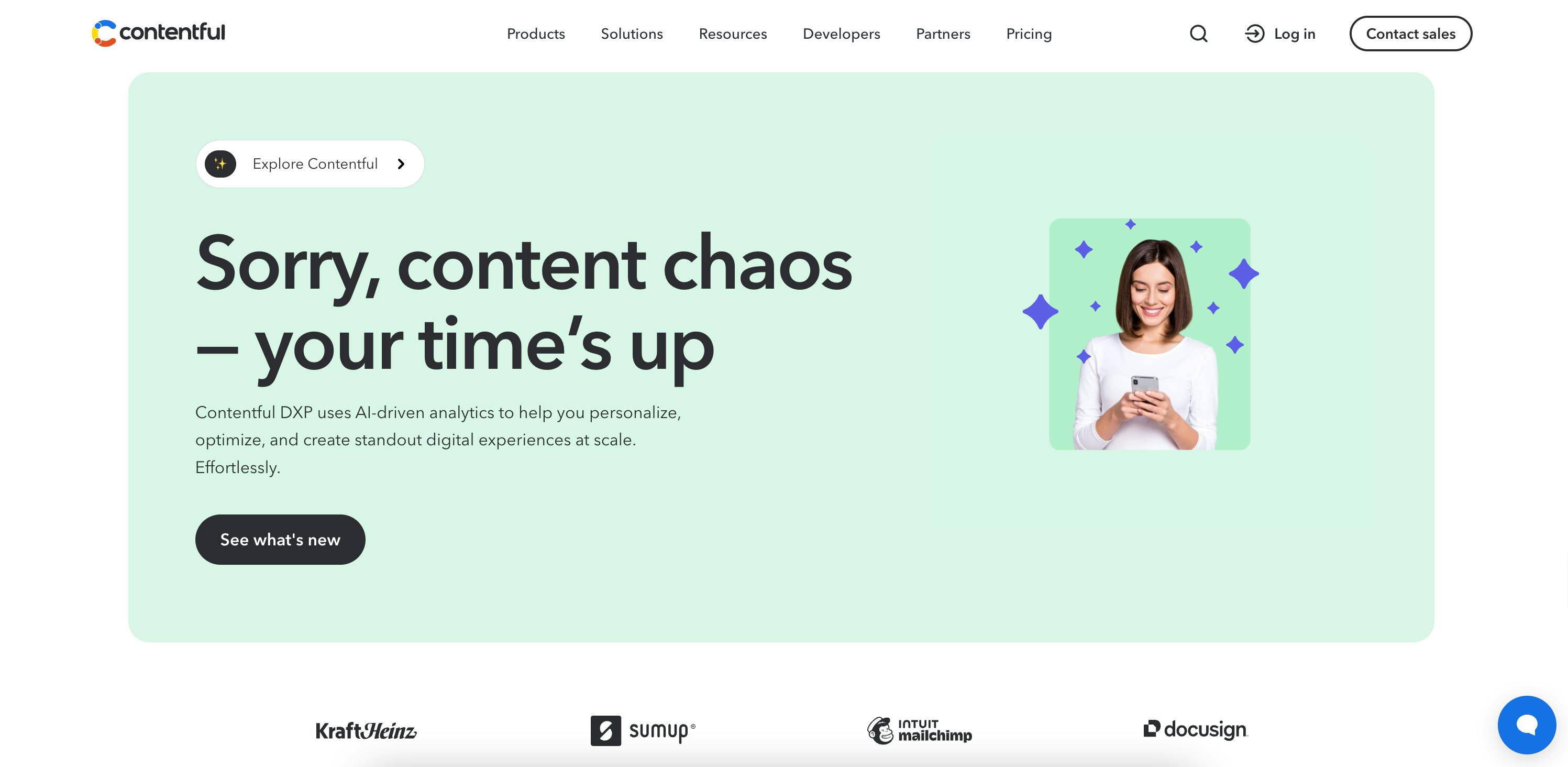
Contentful is one of the most established headless CMS platforms in the market, and it shows in the breadth of its ecosystem. Integrations with Shopify, Salesforce, marketing automation tools, analytics platforms, and dozens of other services are available out of the box or through the marketplace. If your product needs content to flow between multiple enterprise systems, Contentful's partner network is a genuine advantage.
The free tier is enough to build on and can even cater to small teams with its 10-user limit. Contentful also provides both REST and GraphQL APIs, and one-click localization makes it relatively straightforward to support multiple languages once you're on a paid tier with additional locales supported.
One thing to be aware of, though, is the jump up from the free plan. The cheapest paid plan, the Lite plan, is $300/month, a significant step up from $0, and it only includes 20 users, 3 locales, and 1 million API calls per month, with community-grade support. Some of the biggest features, like the visual editor and Contentful Studio, remain paid add-ons with their own custom pricing, which means the editing experience that competitors include for free costs extra here.
Startup Lifecycle
Good at MVP if the free tier covers your needs. Challenging at early Growth due to the pricing step-up. Better suited for well-funded Growth and Scale stages.
Pricing
Paid plans start at $300/month.
The Contentful developer documentation covers API references, SDKs, and integration guides.
6. Hygraph
Best for: startups building scalable apps with tight integration needs.
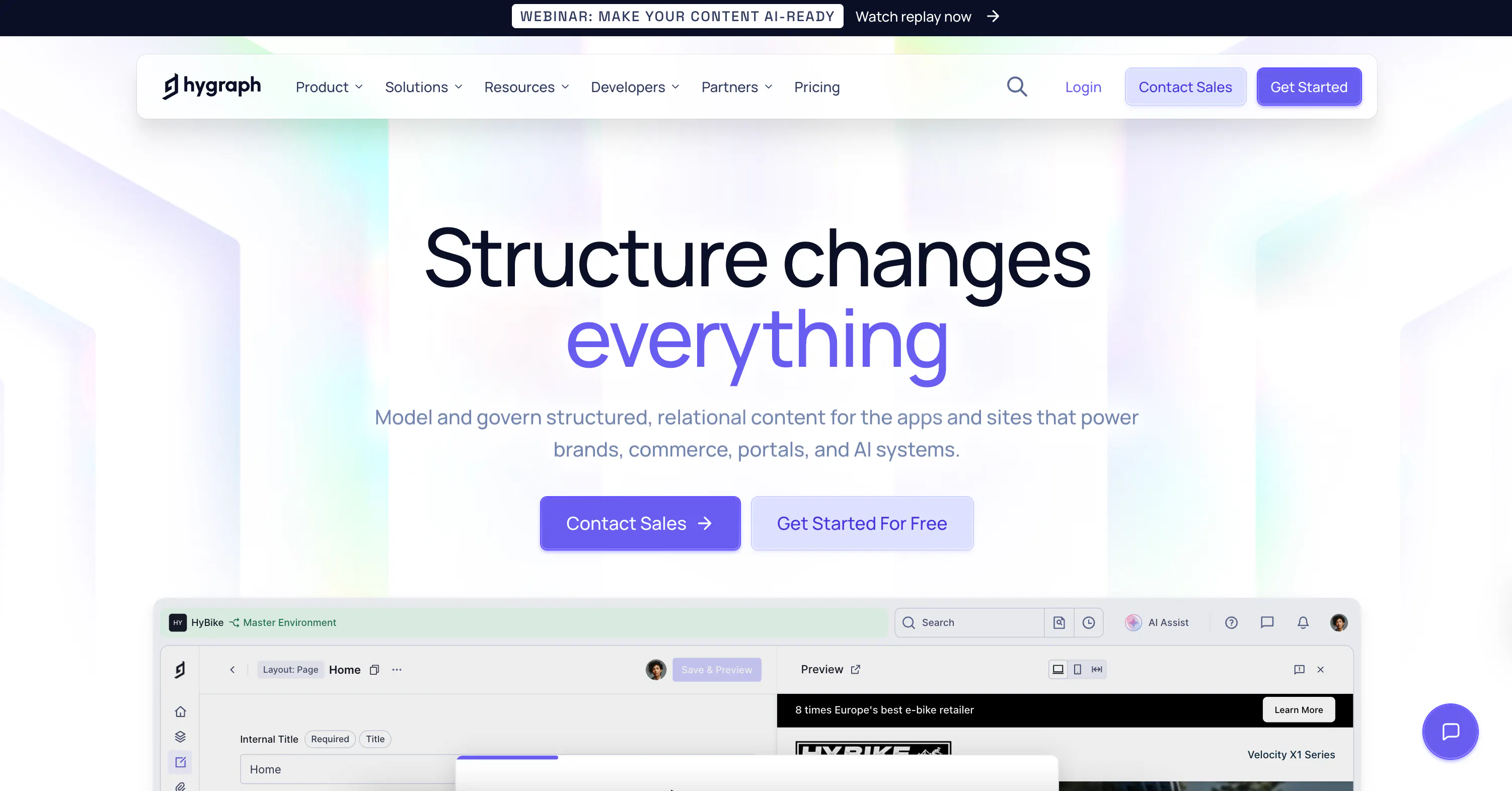
Hygraph (formerly GraphCMS) is built GraphQL-first, which shapes everything about how you interact with it. Your content model is expressed as a GraphQL schema, queries are typed and predictable, and the federation feature lets you connect external data sources into a unified GraphQL API alongside your own content. For a startup building a product where content needs to be stitched together from multiple services, this content mesh architecture is genuinely useful.
The limits on their free plan are tighter than some competitors', though, but for exploration and early development, they're workable. The Growth plan is the cheapest paid plan and jumps up to $299/month, which is a considerable jump and could be a turn-off for startups, especially early ones, with the free plan not being as generous.
Hygraph includes granular roles and permissions even on lower tiers, which is useful when you have a mix of developers, editors, and stakeholders needing different levels of access. Localization support is also strong compared to some alternatives.
The limitation is the GraphQL-first approach itself. If your frontend team is comfortable with GraphQL, this feels natural. If your team is more familiar with REST, or if you're using a framework or library that doesn't have great GraphQL tooling, the learning curve is steeper than it would be on a platform that natively supports REST.
Startup Lifecycle
Good for MVP with technical teams. Strong at Growth and Scale for integration-heavy architectures.
Pricing
Paid plans start at $299/month.
Getting-started guides and API references are available in the Hygraph documentation.
7. DatoCMS
Best for: teams prioritizing
speed of setup and performance for media-heavy content.
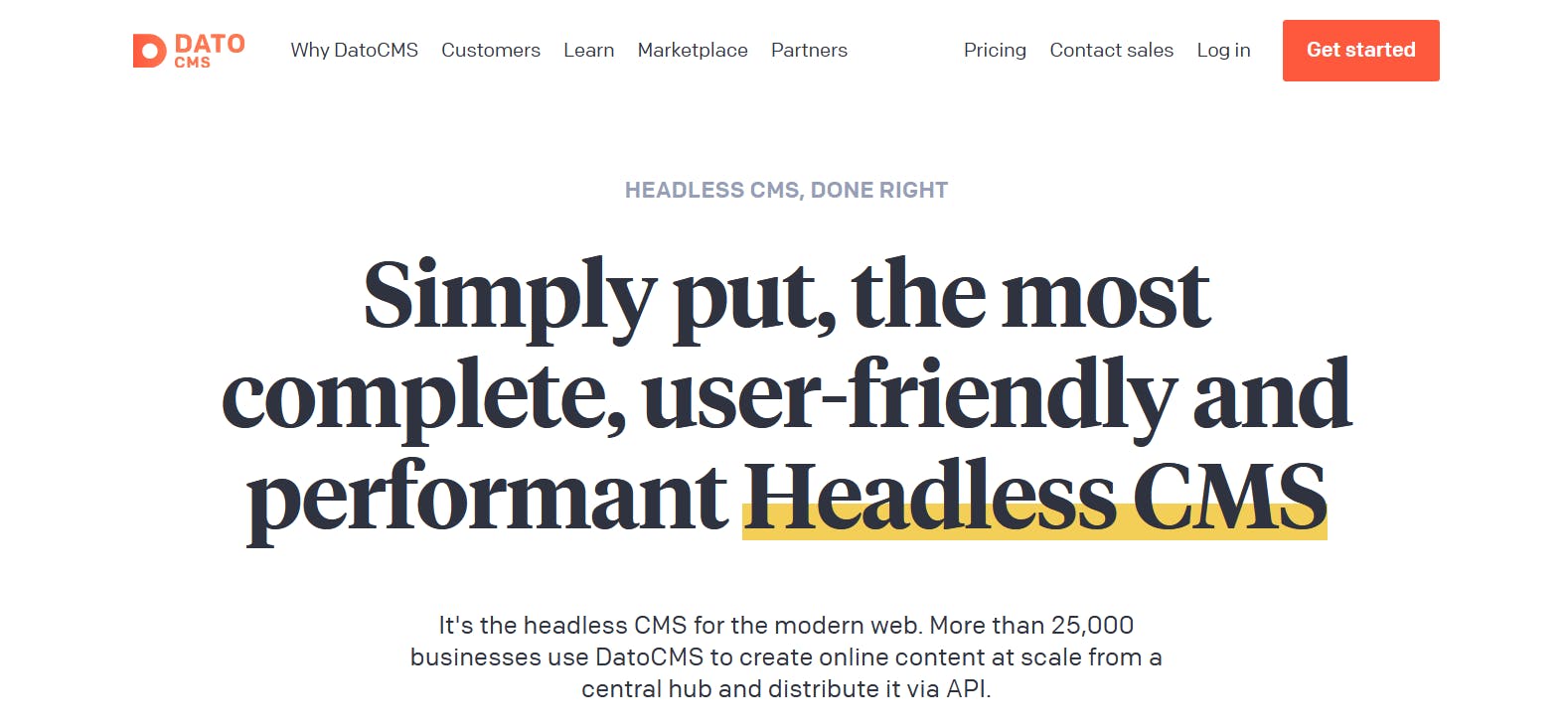
DatoCMS positions itself on speed: fast to set up, fast to deliver content, and fast to iterate. It's GraphQL-first with a real-time content update API, a built-in image CDN that handles resizing and optimization automatically, a plugin system for extending the editor, and granular permissions for team access control. The editor interface is clean and approachable for non-technical users, which means onboarding a marketing team doesn't require a training session.
Its free tier is enough for a proof of concept or a personal project, but it's not a production-grade free plan with potentially restrictive limits and no overages allowed, so most startups will move to the Professional plan fairly quickly.
The main limitation is community size. DatoCMS has a smaller ecosystem of community plugins, third-party tutorials, and Stack Overflow answers than Contentful or Sanity. Sure, it's not a dealbreaker, but it does mean you're more dependent on the official documentation and the DatoCMS support team when you hit a problem, rather than having a raft of existing knowledge to rely on online.
Startup Lifecycle
Quick at MVP. Good through Growth. Scale is feasible but the community is smaller.
Pricing
Pricing starts at €149/month.
The DatoCMS documentation covers GraphQL API usage, image handling, and plugin development.
How to Choose a Headless CMS as a Startup Without Regretting It Later
Now that you know a bit more about each platform, how do you choose the right one? Here are the questions you need to ask to actually determine which platform fits your needs.
How technical is your content team? If the people creating and managing content day-to-day are marketers, founders, or non-engineers, a visual editing experience matters a lot. Storyblok and Prismic are designed with that in mind. Sanity and Hygraph require more comfort with developer-oriented interfaces, though Sanity's Studio is highly customizable if you invest the time.
How fast do you expect content volume to scale? If you're planning to publish hundreds of posts, product pages, and marketing assets within your first year, pay close attention to the limits on free and starter tiers.
Do you need multi-language from day one? If yes, rule out any platform that requires additional locales to jump straight to a paid tier or charges an additional add-on cost.
What's your budget runway? If you're pre-revenue and every dollar counts, Strapi (self-hosted Community edition) or Sanity (free tier with 20 seats) give you the most production-grade capability for zero cost. If you have a small content budget and want a managed service with minimal DevOps, Prismic's $15/month Starter plan and Storyblok's $99/month Growth plan are reasonable first paid steps. While Contentful's $300/month Lite plan is harder to justify until you have predictable revenue.
How important is avoiding migration later? If you want to minimize the risk of needing to migrate, prioritize platforms with open APIs, standard query languages, and good content export options.
Avoiding CMS Vendor Lock-In: What to Look for Before You Sign Up
Vendor lock-in with a CMS comes in a few specific forms, and each one has a concrete check you can run before committing.
- Can you export your entire content library in a standard format? Most platforms say yes, but check whether the export is available on your tier and whether it includes all content types, assets, and metadata. A partial export that requires manual cleanup is not a real migration option.
- Does the content delivery API use a standard protocol? REST and GraphQL are both widely supported, well-documented, and transferable. Sanity uses GROQ, a proprietary query language that's more expressive than GraphQL in some ways but adds a dependency on Sanity's query infrastructure. If you ever migrate away from Sanity, you'll need to rewrite all those queries in whichever query language the new platform uses.
- How is your content schema defined and stored? If the schema lives entirely in a vendor's proprietary GUI and can only be exported in that vendor's format, rebuilding it on a new platform is painful. Sanity's schema-as-code approach in TypeScript is a real advantage here: the schema is in your repository and documents itself.
- Read the terms around pricing changes and data retention. Some platforms have provisions about data deletion after a period of inactivity or plan downgrade, so know what your exit looks like before you're in a position where you need it.
Closing Thoughts
There's no single best headless CMS for every startup. But, there is a best CMS for your startup, and it's probably the one that gets you to published content fastest, keeps costs predictable, and doesn't create a migration crisis six months from now when you're too busy to deal with it.
For most seed-stage teams, that means Sanity if you have strong technical bandwidth and want maximum flexibility, Prismic if you need a fast, visual setup, or Strapi if budget is the dominant constraint and self-hosting is feasible. While Storyblok, Hygraph, Contentful, and DatoCMS also have their own specific context where they're the right fit.