
TL;DR Quick Picks for 1:1 ABM Tools
The top AI tools for 1:1 ABM in 2026 break down into three categories: landing page builders for personalized destinations, intent platforms for identifying in-market accounts, and multi-channel engagement tools for coordinated campaigns. Leaders like 6sense and Demandbase handle intent and orchestration, while tools like Mutiny focus on website personalization. For landing page generation at scale, dedicated builders like Prismic turn one approved page into hundreds of tailored variations. RollWorks and Terminus excel at account-based advertising and multi-channel campaign execution.
1:1 ABM campaigns promise relevance at the account level, but most teams hit the same wall: they have the data, they have the strategy, and they have zero capacity to turn insights into personalized landing pages for hundreds of accounts. AI tools have changed that math entirely.
This guide covers the top AI-powered tools for running 1:1 ABM in 2026, from intent platforms that identify in-market accounts to landing page builders that generate tailored variations at scale, plus how to choose the right stack for your team.
ABM landing page builder feature comparison table
Tool | Best For | Primary Use Case |
|---|---|---|
Prismic ABM Landing Page Builder | Personalized landing pages at scale | Destination pages |
Mutiny | Website personalization | On-site experiences |
Demandbase One | Full-stack ABM orchestration | Enterprise programs |
6sense | Intent data and account prioritization | Account selection |
Tofu | Multi-channel content generation | Campaign assets |
RollWorks (AdRoll ABM) | Account-based advertising | Display and retargeting |
Terminus | Multi-channel ABM campaigns | Full lifecycle engagement |
UserLed | ABM experimentation | A/B testing |
Why AI Changes How Teams Run 1:1 ABM Campaigns
Here's the core problem AI solves: teams have more account data than ever, but they lack the production capacity to turn insights into personalized experiences.
Before AI, one personalized landing page required writing, design, and sometimes dev resources - per account. That math doesn't work when you're targeting hundreds of accounts. With AI, one base page becomes dozens of tailored variations using existing data. The bottleneck shifts from production to strategy.
Best AI Tools for 1:1 ABM Campaigns
Here are the top AI-powered tools for running 1:1 ABM campaigns, organized by primary function. Most teams use a combination.
1. Prismic ABM Landing Page Builder
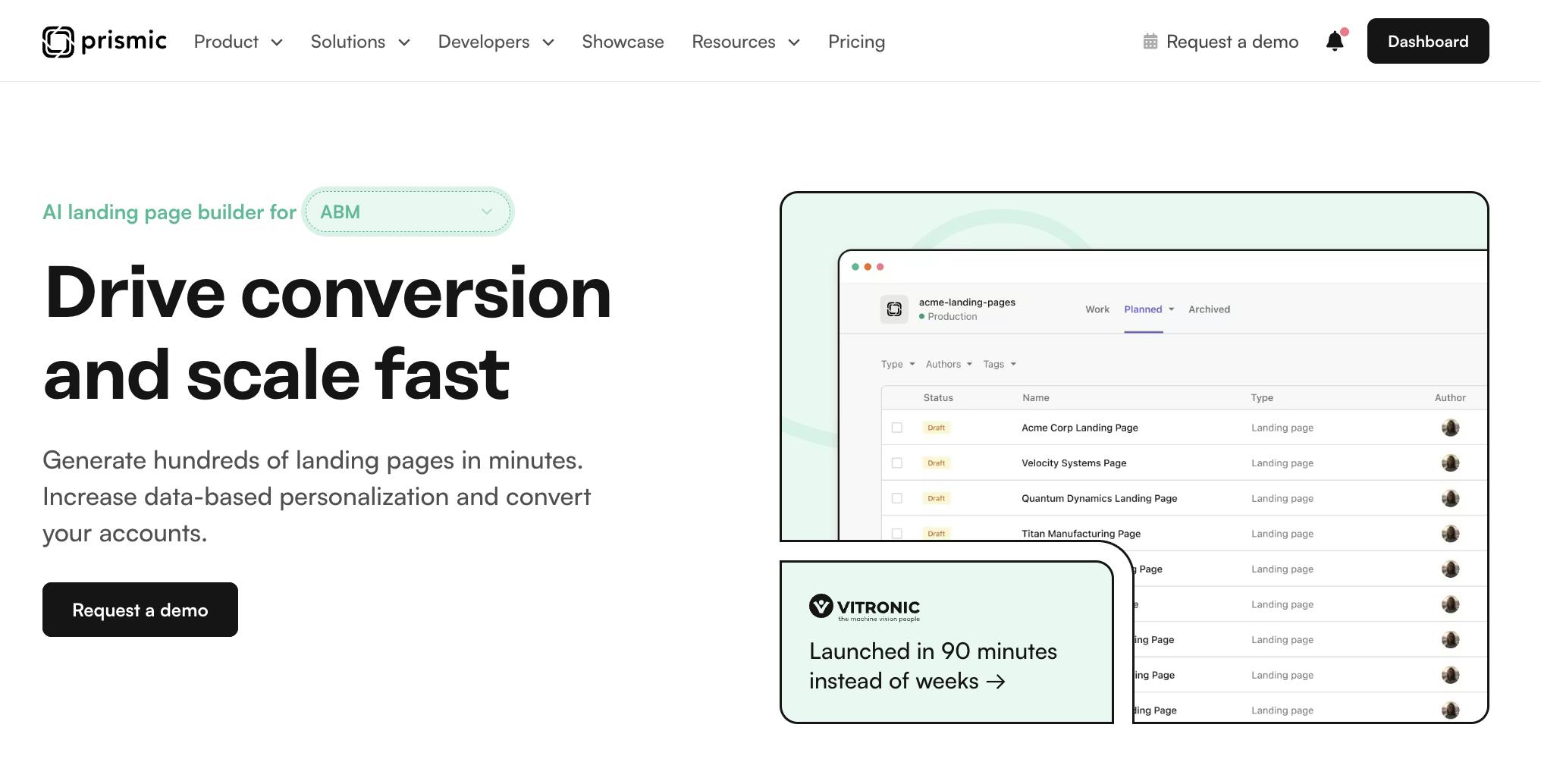
Prismic's ABM landing page builder is a marketing-only tool for teams who want personalized landing pages without dev dependency. You create a single base page that locks in your design and brand voice, upload account data from your CRM or enrichment tools, and generate dozens of variations that adapt the narrative to each account's context.
How it works:
- The system identifies meaningful angles in your data—industry context, likely pain points, relevant use cases—and tailors the messaging so each page feels crafted for that account
- Pages arrive as editable drafts in organized batches, so marketing can review and approve before publishing
- Account-level engagement tracking lets teams measure traction early
What sets Prismic apart:
- Marketing-first approach: Unlike platforms that require developer involvement for every campaign update, marketing teams own the entire workflow from template creation to publishing
- Brand consistency at scale: Locked base template system ensures visual design and core positioning remain intact across all variations while messaging adapts to each account
- Batch generation and review: Generate fifty (or as many as you want) variations, review them in an organized queue, make bulk edits where needed, and publish all approved pages simultaneously
Data integration:
- Direct integrations with popular enrichment platforms and CRMs
- Pulls in firmographic data, technographic information, and custom fields without manual data entry
- Leverage existing investments in data infrastructure rather than starting from scratch
Real results: VITRONIC launched a 60-page personalized ABM campaign in about 90 minutes—work that previously took weeks of coordination across design, copy, and development teams. The time savings compound when you factor in campaign iterations and updates, which can be deployed across all account variations in minutes rather than requiring individual page edits.

2. Mutiny
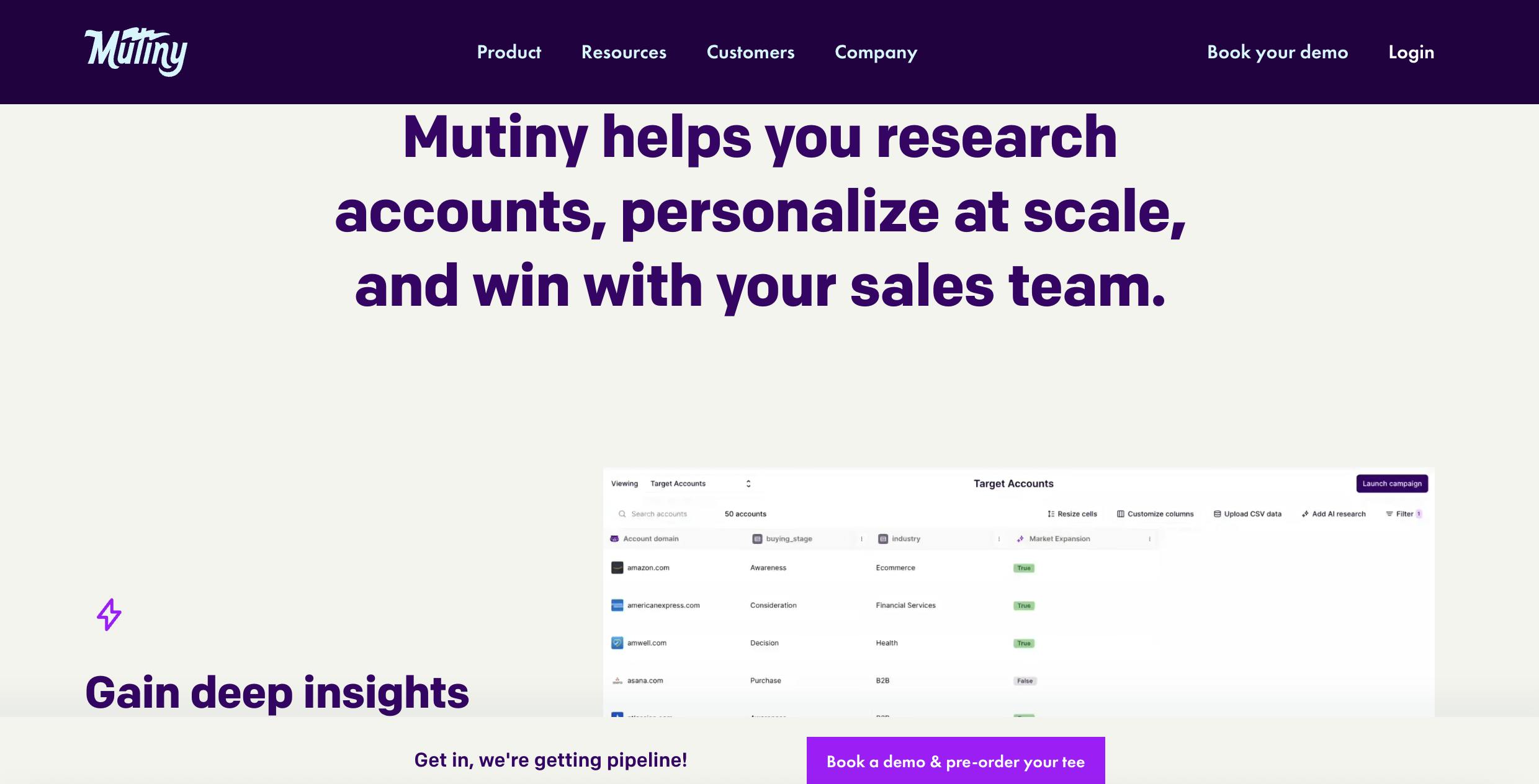
Mutiny personalizes your existing website for target accounts. Rather than building separate landing pages, Mutiny modifies on-page content based on visitor attributes—showing different headlines, CTAs, or social proof depending on who's viewing.
How it works:
- Identifies visitors through reverse IP lookup and cross-references them against your target account list
- Dynamically adjusts content in real time when someone from a priority account lands on your site
- Changes can include hero headlines, case study logos, CTAs, and more based on company size and buying stage
Best use cases:
- Personalizing high-traffic pages that would be impractical to recreate as separate landing pages for each account
- Homepage, product pages, and pricing page personalization
- Inbound-heavy ABM strategies where target accounts discover you through organic search or paid media
Key features:
- A/B testing capabilities to validate which personalization strategies drive conversions
- Account-level analytics showing which target accounts have engaged with personalized experiences
- Integrations with major marketing automation platforms, CRMs, and data warehouses
Ideal for: Teams wanting to personalize their main site experience without creating standalone pages for each account, ensuring target account visitors encounter relevant messaging the moment they arrive.
Want to see how account-level landing pages work in practice?
👋 Prismic’s ABM landing page builder is designed for teams scaling one-to-one ABM without increasing production overhead.
3. Demandbase One
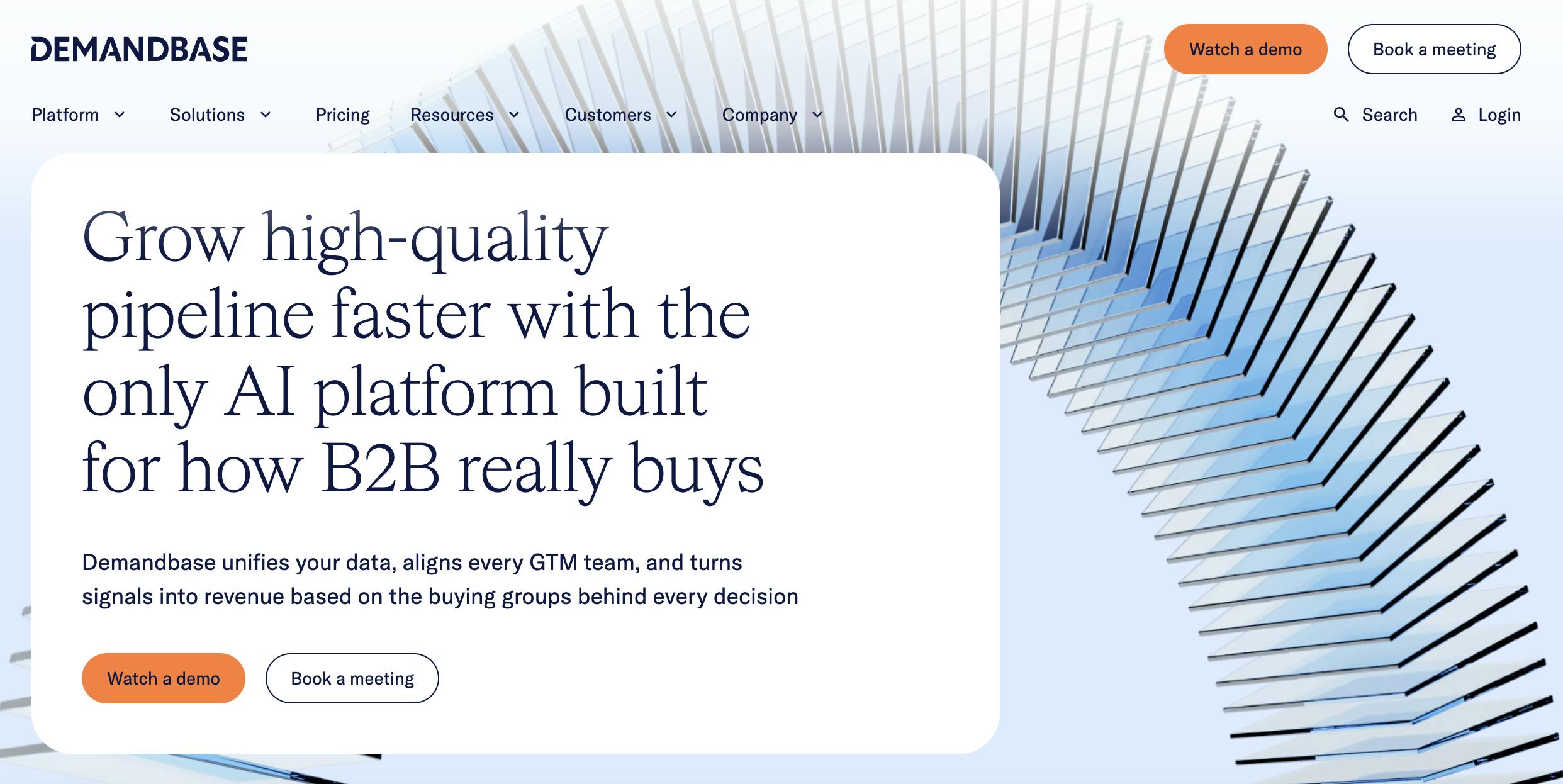
Demandbase One is an enterprise ABM platform that combines advertising, web personalization, and intent data into a single orchestration layer. It's built for large teams running complex, multi-channel ABM programs who want unified reporting and campaign management across touchpoints.
Core capabilities:
- Unified orchestration: Connects account identification, intent monitoring, ad targeting, website personalization, and sales intelligence into one system
- Intent data engine: Monitors billions of buying signals across the web to identify accounts showing active interest in solutions like yours
- Account scoring: Prioritizes accounts based on engagement intensity and buying stage to help teams focus on accounts most likely to convert
- Account-based advertising: Target decision-makers at in-market accounts with personalized creative across display, social, and video channels
Web personalization:
- Content adapts based on industry, company size, previous engagement history, and current buying stage
- Integrates more tightly with the broader Demandbase ecosystem than standalone personalization tools
- Sales teams receive real-time alerts when priority accounts show high-intent behavior
Enterprise features:
- Orchestration infrastructure for ABM programs across multiple regions, business units, or product lines
- Maintains consistency while allowing localized customization
- Consolidated reporting across all channels to demonstrate ABM impact and optimize spend allocation
Ideal for: Large teams managing complex, multi-channel ABM programs where marketing and sales need to work from the same account prioritization and engagement history.
4. 6sense
6sense focuses on intent data and predictive analytics. It identifies accounts showing buying signals before they raise their hand, helping teams prioritize which accounts to target and when. If your primary challenge is account selection and timing rather than content personalization, 6sense fills that gap.How intent monitoring works:
- Monitors anonymous buyer research behavior across millions of web properties
- Identifies patterns that indicate an account is entering a buying cycle
- Tracks keyword research, content consumption, competitor evaluation, and solution category exploration
- AI models predict which accounts are in-market and what stage of the buying journey they're in
Buying committee visibility:
- Surfaces buying committee members even before they've engaged directly with your brand
- Identifies multiple stakeholders within target accounts who are researching related topics
- Gives sales teams a complete picture of who's involved in the decision and what concerns each stakeholder is researching
Predictive scoring:
- Evaluates entire accounts based on collective behavior across all touchpoints
- Aggregates research activity across the buying committee to identify serious buyer intent
- Prevents teams from overlooking accounts that don't fit traditional engagement thresholds but are actually deep in evaluation
Integration and orchestration:
- Syncs with major CRM and marketing automation platforms to share account scores and buying stage information
- Includes orchestration capabilities for coordinating outreach across channels based on account status
- Most teams use 6sense primarily for its intent intelligence and combine it with other tools for content creation
Ideal for: Teams whose primary challenge is identifying which accounts to target and when, rather than creating personalized content once target accounts are selected.
5. Tofu
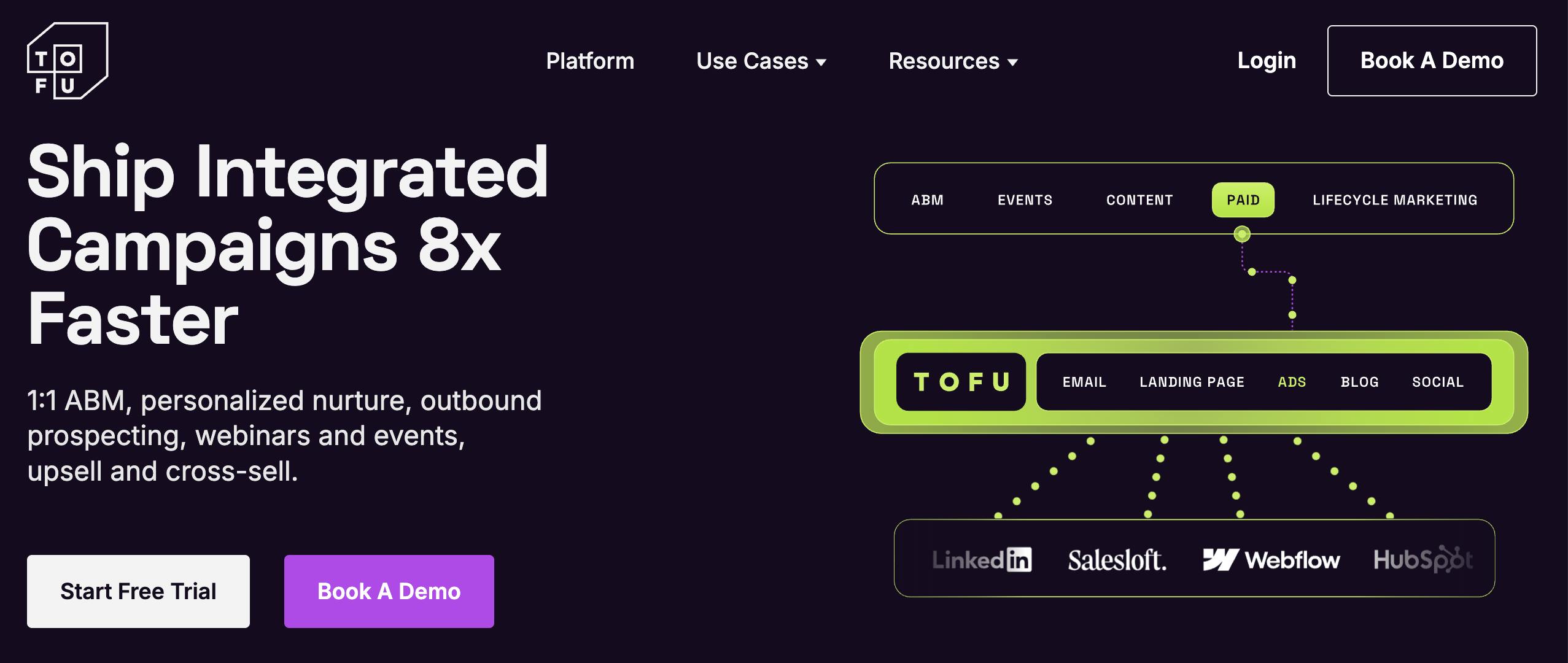
Tofu is an AI content platform that generates personalized campaign assets across channels—ads, emails, and landing pages—from a single brief. It's useful for teams wanting multi-channel content variations quickly, though the landing page output may require more customization than dedicated page builders.
How it works:
- Start with a campaign brief specifying your target audience, core value proposition, key messaging points, and desired tone
- Generates coordinated assets across formats: social ads, display banners, email copy, landing page content, and video scripts
- Maintains consistent messaging while adapting format-specific best practices for each channel
ABM-specific capabilities:
- Create account-specific variations by inputting firmographic data and customization parameters
- Generate different asset sets for different verticals (e.g., financial services emphasizing compliance, healthcare focusing on patient outcomes, manufacturing highlighting operational efficiency)
- Test different messaging angles quickly across multiple account segments
Content quality:
- Strong output for short-form content like ad copy and email subject lines
- Longer-form content like landing pages often benefits from more editing and refinement
- Speed advantage: generate dozens of asset variations in the time it would take a copywriter to draft a few headlines
Collaboration features:
- Teams can review, comment on, and iterate on generated content before finalizing
- Platform learns from your edits and feedback to better match your brand voice over time
- Improves output quality with continued use
Ideal for: Teams running high-velocity ABM campaigns across multiple channels who need to accelerate content creation while ensuring messaging consistency across touchpoints.
6. Rollworks (AdRoll ABM)
RollWorks, now unified under the AdRoll ABM brand, is an account-based advertising platform built for B2B teams who want precise targeting and multi-channel ad orchestration. The platform combines account identification, predictive scoring, display advertising, and CRM integration to help teams run coordinated ABM campaigns across web, social, and connected TV.
Core advertising capabilities:
- Account-based display advertising: Run targeted display ads specifically to decision-makers at your target accounts across major ad networks
- Dynamic CPM bidding: BidIQ technology determines optimal ad placement and pricing to maximize ROI
- Multi-channel reach: Deploy campaigns across web (desktop and mobile), apps, LinkedIn, and Connected TV
- Retargeting: Target accounts who have previously visited your website with tailored messaging based on their engagement
Account intelligence and scoring:
- ICP Fit Grade: AI-powered scoring (A-F) that evaluates how closely each account matches your ideal customer profile based on firmographic and technographic data
- Intent data integration: Powered by Bombora, includes full open-text intent data search to identify accounts researching specific topics, products, or competitors
- Buying stage tracking: Journey Stages feature tracks account progression through the buying cycle
- Engagement aggregation: Unified view of account activity across all touchpoints to identify high-engagement accounts
Campaign management:
- Campaign Playbook wizard: Guided setup that walks teams through ABM best practices for audience definition, ad formats, budget, and timing
- Command Center dashboard: Centralized view showing which target accounts are in which funnel stage and suggesting next-best actions
- Workflow automation: Automated sequences that trigger actions across channels based on engagement signals
Integration and reporting:
- Direct integrations with Salesforce, HubSpot, and Marketo bring engagement data and intent signals into your CRM
- Account-level analytics track reach, impressions, clicks, and progression rather than individual visitor metrics
- Multi-touch attribution shows how different touchpoints contribute to pipeline
Ideal for: B2B marketing teams who want to run sophisticated account-based advertising campaigns with strong targeting capabilities, particularly those prioritizing display ads and retargeting as core ABM tactics. Best suited for teams with defined target account lists who want advertising that complements their broader ABM strategy.
7. Terminus
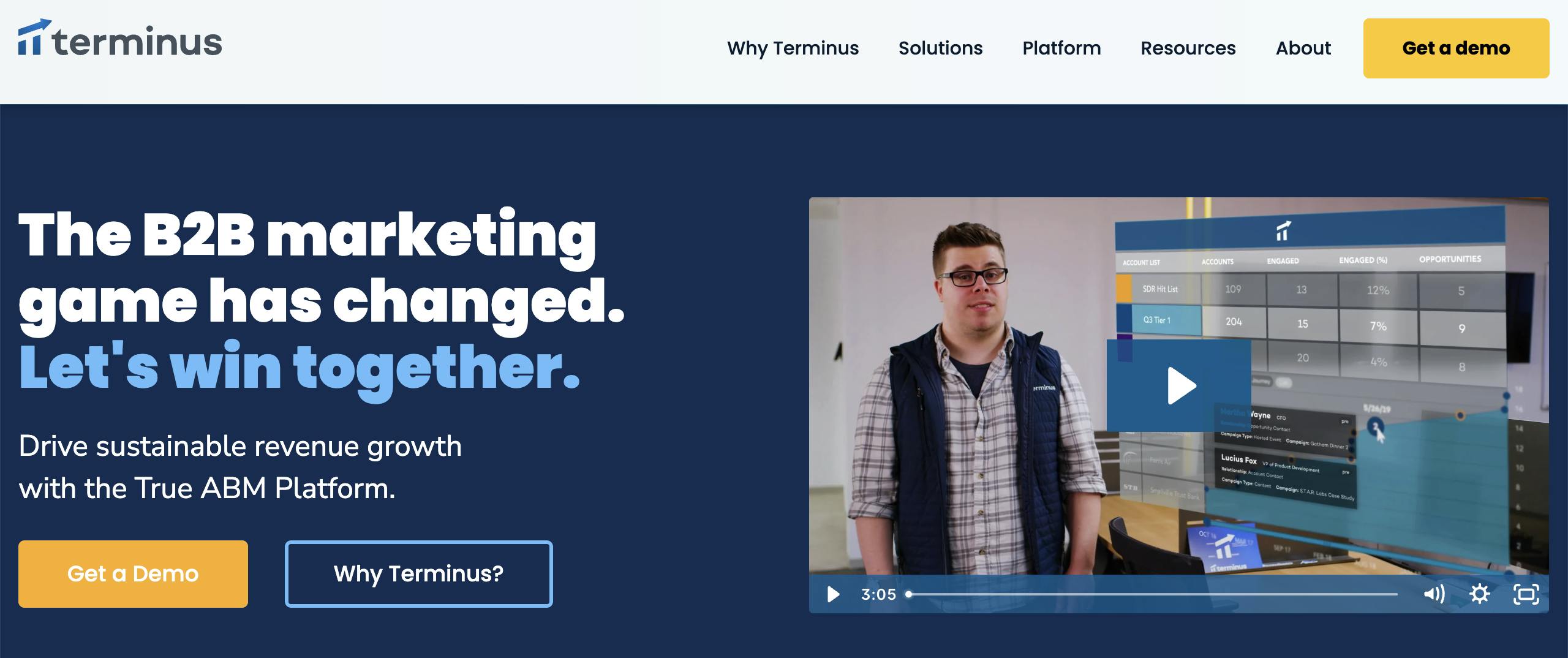
Terminus is a comprehensive ABM platform designed to engage target accounts across their entire lifecycle—from initial awareness through customer expansion. The platform combines account-based advertising, multi-channel orchestration, intent data, and measurement capabilities into what they call the "True ABM Platform."
Multi-channel engagement:
- Account Hub: Centralized command center that aggregates first-party and third-party data to provide a 360-degree view of all target accounts
- Display advertising: Run awareness and lead generation campaigns targeting specific accounts across major ad networks
- LinkedIn integration: Sync target account lists to LinkedIn Ads for coordinated social advertising
- Email signature marketing (Sigstr): Transform employee email signatures into personalized ABM touchpoints with differentiated banner content based on recipient account
Account identification and prioritization:
- Predictive account identification: Uses AI to identify and segment high-value target accounts based on fit and buying signals
- Intent data: Bombora-powered intent monitoring shows what topics your target accounts are researching across the web
- Anonymous visitor identification: Reveals which target accounts are visiting your website, even when individual visitors remain anonymous
- Engagement scoring: Identifies surging accounts showing increased engagement across multiple channels
Sales activation:
- Account-level engagement alerts: Notifies sales teams when priority accounts show high-intent behavior or engagement spikes
- Buying committee visibility: Provides insights into multiple stakeholders at target accounts who are engaging with your content
- CRM enrichment: Pushes valuable account data and engagement signals directly into Salesforce, HubSpot, or other CRM systems
Measurement and attribution:
- Measurement Studio: Tracks marketing impact from campaign-level metrics to board-level dashboards
- Multi-touch attribution: Shows how different channels and touchpoints contribute to pipeline and revenue
- Account progression tracking: Monitors how accounts move through stages from awareness to opportunity to closed-won
Implementation and support:
- Tactical playbooks: Pre-built ABM frameworks help teams at different maturity levels—crawl, walk, run
- Customer success teams: Dedicated support helps develop and refine ABM strategy aligned with business needs
- Integration ecosystem: Connects with major marketing automation platforms, CRMs, and data providers
Ideal for: B2B organizations committed to a comprehensive account-based approach across marketing, sales, and customer success. Particularly valuable for teams with tightly defined target account lists who want to orchestrate consistent, personalized experiences across the entire customer lifecycle—from acquisition through renewal and expansion. Best for mid-market to enterprise companies ready to invest in full-featured ABM infrastructure.
8. UserLed
UserLed is a multi-channel ABM experimentation platform for teams running structured A/B tests across personalized experiences. It's valuable for optimizing ABM programs over time, though it assumes you already have the infrastructure to create variations.
Account-level experimentation:
- Test different personalization strategies, messaging angles, and content formats
- Focuses specifically on account-level experimentation where sample sizes are smaller
- Uses statistical approaches designed for ABM contexts rather than traditional broad audience testing
Testing scenarios:
- Whether accounts in financial services respond better to ROI-focused messaging versus risk mitigation positioning
- If mid-market accounts convert at higher rates from case study-heavy landing pages versus product demo-focused pages
- Which combination of value propositions and social proof resonates with specific verticals
Multi-channel testing:
- Coordinate experiments across website personalization, landing pages, email sequences, and ad creative
- Understand how different touchpoints work together
- Test whether personalized ads followed by generic landing pages perform better or worse than consistent personalization across the entire journey
Statistical guidance:
- Designed for ABM contexts where you're testing with dozens or hundreds of accounts rather than thousands of individual visitors
- Helps teams avoid common pitfalls like calling tests too early or over-optimizing for noise in small sample sizes
- Tracks engagement at the account level rather than individual visitor level
- Aggregates behavior across all stakeholders within a target account for clearer signals
Ideal for: Mature ABM programs looking to systematically improve performance rather than guessing what works, providing the experimentation infrastructure to make optimization decisions based on evidence rather than intuition.
How to Choose the Best ABM Tools for Your Team
The right tool depends on your ABM maturity, available resources, and how many accounts you're targeting.
Match the tool to your ABM tier
ABM programs typically operate across three tiers, and each has different tool requirements:
- 1:1 ABM (top accounts): Requires deep personalization tools like dedicated landing page builders and web personalization platforms
- 1:few ABM (account segments): Benefits from segment-based personalization and intent platforms that group similar accounts
- 1:many ABM (broad targeting): Can leverage advertising platforms and content tools with lighter personalization
Evaluate your technical resources
Some tools require developer involvement for setup and maintenance. Others are built specifically for marketing teams to operate independently. If you don't have dedicated dev support for ABM, prioritize tools with visual editors and no-code workflows.
Consider your target account volume
Targeting ten accounts has different requirements than targeting five hundred. High-volume programs benefit from batch generation capabilities and streamlined QA workflows—otherwise, the review process becomes the new bottleneck.
Common Mistakes When Scaling 1:1 ABM Campaigns
Here are the pitfalls that undermine ABM personalization at scale.
Relying on shallow token replacement
Swapping company names throughout a template isn't personalization—it's mail merge. Buyers who've experienced genuinely tailored messaging from one vendor now expect that level of relevance everywhere. Generic token replacement actually highlights that you didn't put in the effort.
Ignoring brand consistency at scale
Generating hundreds of pages creates drift risk. Without a locked base template and approval workflows, variations can stray from brand voice, use inconsistent messaging, or introduce errors. The speed gains from AI disappear if you're spending hours fixing quality issues.
Skipping the landing page conversion layer
Many teams personalize ads and emails but send traffic to generic landing pages. That breaks the personalized experience at the exact moment of conversion. The landing page is where your ABM story either connects or falls apart—it's the destination that continues the conversation your outbound started.
Ready to turn one landing page into hundreds of personalized variations?
👋 Prismic's ABM landing page builder lets marketing teams generate tailored pages at scale using data you already have - without dev tickets or production bottlenecks.
FAQs About AI Tools for 1:1 ABM Campaigns
You might also like...